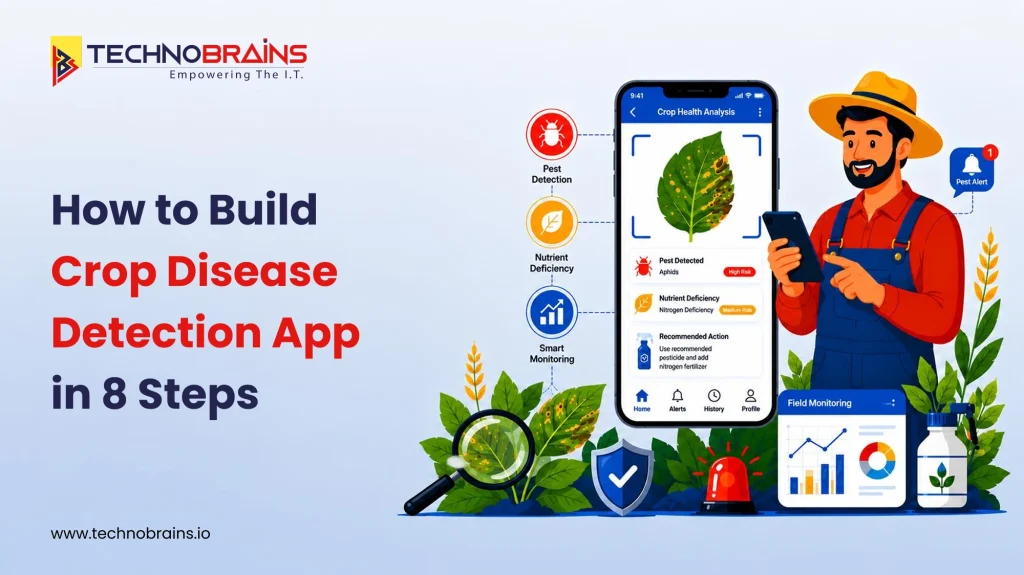
Farmers need better ways to identify crop diseases, pests, and nutrient deficiencies because their current methods fail to detect problems until they spread. This app helps farmers minimize crop losses while enabling them to make faster decisions about their fields.
The 2026 report projects that the global AI in agriculture market will expand from $7.5B in 2026 to $77B by 2036, underscoring the growing demand for AI-based agricultural technology.
Farmers can use their crop images to obtain immediate insights through AI-based plant disease detection technology. The development of smart farming applications creates significant business opportunities for companies.
How Crop Disease Detection Apps Identify Pests, Infections, and Nutrient Deficiencies
Crop disease detection apps use computer vision and machine learning to analyze crop images and identify potential health issues. Farmers can capture photos of leaves, stems, or affected plants using a smartphone, and the app quickly scans the images for visible signs of diseases, pest infestations, or nutrient deficiencies.
Most AI-powered plant disease detection systems are trained on thousands of images of healthy and infected crops. By comparing uploaded images with these datasets, the system can accurately recognize disease symptoms, insect damage, and nutritional imbalances. This allows farmers to receive instant diagnoses and take corrective action before problems spread across the field.
Some advanced crop monitoring platforms also combine image analysis with real-time data from weather conditions, soil sensors, drones, and IoT devices. These insights enable predictive analytics, helping farmers identify potential risks before visible symptoms appear.
Key Technologies Required to Build an AI Crop Monitoring App
To build an application detecting plant disease, we need several key technologies. It helps us make the app more accurate and better at monitoring crops promptly. Here are some of them:
- Machine Learning: Used to train models with pictures of crops. This helps the app learn to detect diseases.
- Computer vision: Helps the app scan images and recognize symptoms.
- Cloud computing: Cloud helps run real-time crop monitoring with secure storage, faster processing, and scalable infrastructure.
- IoT sensors: They are used to track conditions in the soil and environment.
- GPS and drone technology: Help monitor crops better in the field.
Step-by-Step Process to Build a Crop Disease Detection App
Building a plant disease detection app requires a combination of AI models, agricultural datasets, computer vision technology, and scalable cloud infrastructure. Businesses investing in smart farming solutions focus on delivering accurate disease detection, automated monitoring, and real-time crop health insights.
1. Define farming objective
The first step is to identify the crops, diseases, pests, and nutrient deficiencies the application will monitor. Businesses should also determine whether the app will support specific farming practices, regions, or plant varieties. Defining clear objectives helps establish the scope of the project and ensures the solution addresses real agricultural challenges.
2. Collect crop datasets
High-quality data is the foundation of every AI-powered system. Collect thousands of images of healthy and infected plants across different crop types, growth stages, and environmental conditions.
3. Annotate and Organize Training Data
Once the data is collected, each image must be labeled and categorized based on disease type, pest damage, nutrient deficiency, or crop condition. Accurate annotation helps machine learning models understand visual patterns and improves the reliability of disease predictions.
4. Train AI models
Use Machine Learning and Deep Learning models to analyze crop images and identify plant health issues. Computer vision algorithms learn to recognize symptoms such as discoloration, leaf spots, wilting, pest damage, and nutrient deficiencies. Continuous training and validation improve the model’s accuracy over time.
5. Build an image processing workflow
Develop an image-processing pipeline that captures, preprocesses, and analyzes crop images. This workflow typically includes image enhancement, segmentation, feature extraction, and disease classification. A well-designed workflow ensures faster and more accurate diagnosis.
6. Develop a farmer interface
The crop disease detection application requires you to develop straightforward dashboards and mobile interfaces, which will enable users to monitor crops more efficiently.
Create both mobile and web interfaces that allow farmers to upload crop images, view disease reports, receive treatment recommendations, and monitor crop health. Easy-to-use dashboards improve adoption and help farmers make faster decisions in the field.
7. Integrate smart farming features
Enhance the application by integrating additional precision agriculture capabilities such as weather forecasting, pest detection, irrigation recommendations, fertilizer guidance, satellite imagery, IoT sensor integration, crop health monitoring, and predictive analytics.
These features transform the application from a disease detection tool into a comprehensive smart farming platform.
8. Deploy infrastructure
Build the solution that uses scalable cloud infrastructure with secure APIs, encrypted data storage, user authentication, and high-performance backend services. A well-designed architecture ensures the platform can support thousands of concurrent users while maintaining reliability and data security.
9. Test and Validate System
Before launch, test your app across different crops, environmental conditions, and image quality scenarios to validate model performance.
After deployment, continuously monitor system accuracy, retrain AI models using newly collected agricultural data, and release regular updates to improve disease detection capabilities. Partnering with experienced AI developers helps ensure the platform continues to evolve alongside changing farming conditions and emerging crop diseases.
Build a Smarter Crop Disease Detection App
Create an AI-powered app that helps farmers detect crop diseases, pests, and nutrient issues faster with real-time image analysis.
Build Your Agriculture AI App!
Must-Have Features for a Smart Crop Monitoring App
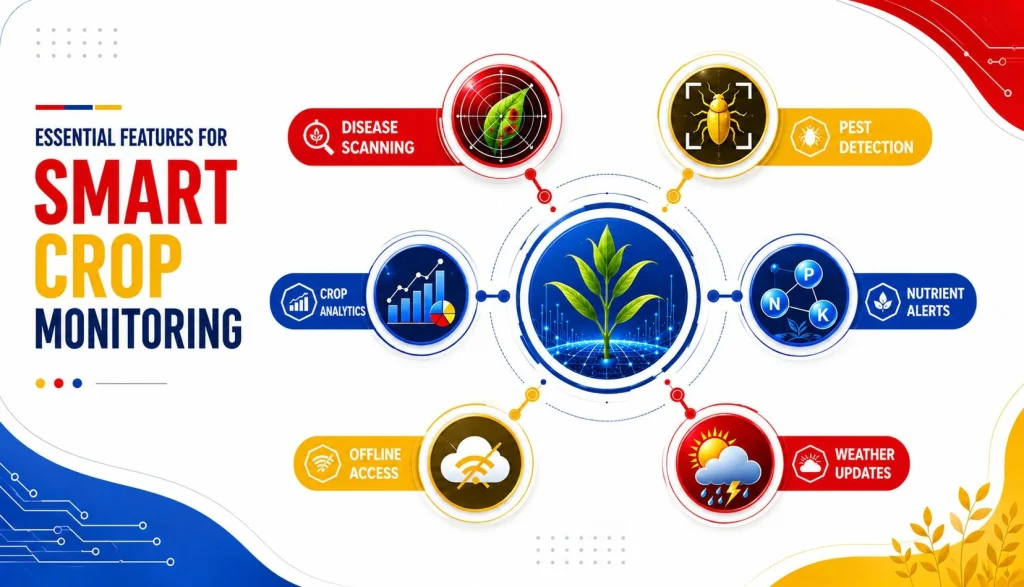
A successful farming solution needs more than basic monitoring. Modern agriculture businesses want intelligent platforms that combine AI, computer vision, IoT, and real-time analytics to help farmers detect problems, optimize crop health, and make data-driven decisions. The following features form the foundation of a scalable and effective smart farming solution.
- A crop monitoring app with real-time disease scanning helps farmers find infections away by uploading pictures from their mobile phones.
- A pest detection app for agriculture can spot insects before they spread to other parts of the field.
- A nutrient deficiency detection app helps farmers see soil and crop health problems.
- Accessibility makes it easier for farmers to use the app in remote areas with poor internet.
- Weather-based alerts help farmers take steps to prevent disease outbreaks.
- Multi-crop support lets farmers monitor types of crops in various environments.
- Storage and analytics help businesses that offer agriculture AI app development services manage big farming data efficiently.
Common Challenges in Crop Disease Detection App Development and How to Solve Them
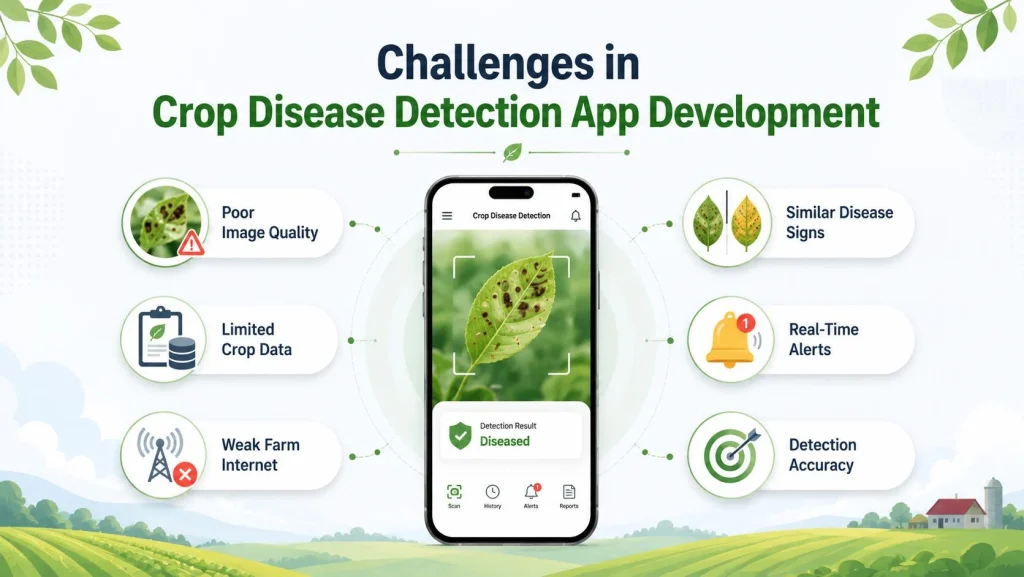
Building a crop disease detection app comes with real challenges like poor image quality, limited datasets, and unreliable internet in rural areas. Solving these issues is important to improve accuracy and make the app useful for farmers in real conditions.
Poor image quality
AI systems experience performance problems when dealing with images that are either blurry, have poor lighting, or lack clear definition. The solution requires crop disease detection applications to implement three functions, which include image quality assessment, camera usage instructions, and image preprocessing capabilities as essential components for their analysis process.
Limited datasets
The available image data for most agricultural diseases does not cover specific geographic regions. Companies will improve their business operations by developing local databases, which they will use to train their models through expert-annotated images, while their disease detection systems will receive updates from newly collected specimen data.
Weak internet
Farms experience connectivity problems because their internet connections are either weak or unpredictable. The application provides farmers with access to its features through internet-deficient areas because the system combines offline support with edge AI technology and lightweight models.
Similar symptoms
Various crop diseases, pest infestations, and weather-related crop stress all display identical visual symptoms. The machine learning system for detecting crop diseases needs to use both image analysis and data about crop type, location, weather conditions, and growth-stage development to achieve accurate results.
Real-time monitoring
Large farms require quick disease alerts that need to function without any interruptions at all times. The implementation of a continuous crop disease monitoring system requires IoT sensors, drone imaging technology, and automated alert systems.
Accuracy issues
The success of AI predictions depends on the model training process meeting the required standards for its implementation. The accuracy of crop disease detection applications will improve through ongoing model testing combined with expert validation and agricultural computer vision technology.
Need expert help with crop monitoring app development?
Get a custom crop monitoring solution with AI, computer vision, pest detection, and real-time alerts built for your farming business.
Talk to Our AI Experts!
Cost to Build a Crop Disease Detection App with AI and Computer Vision
The cost of building a crop disease detection app depends on how complex the AI’s features are, what kind of infrastructure is required, and how big the deployment will be. When businesses invest in developing a crop disease detection app, they usually focus on building an architecture that has real-time monitoring and automating tasks intelligently to make farming operations better.
Adding features like using AI to detect plant diseases, integrating with the cloud, recognizing images, and analyzing data to make predictions can make the overall development cost go up. Companies that offer services for mobile app development and farming app development should consider preparing datasets for training AI models and maintaining the app over time when they estimate the project budget for crop disease detection app development.
| Development Component | Estimated Cost Range |
|---|---|
| UI/UX Design | $3,000 – $8,000 |
| AI Model Training | $8,000 – $20,000 |
| Backend & Cloud Infrastructure | $5,000 – $15,000 |
| Image Recognition Integration | $4,000 – $12,000 |
| Real-Time Monitoring Features | $5,000 – $10,000 |
| Testing & Deployment | $3,000 – $7,000 |
| Total Estimated Cost | $25,000 – $70,000+ |
Conclusion
Companies that want to build a crop disease detection app are using AI and computer vision to reduce crop loss, detect diseases faster, and support better farming decisions. These technologies are becoming important for modern farming and precision agriculture.
As demand for automation grows, businesses investing in smart farming app development and crop monitoring app development can help farmers monitor crops in real time, identify risks early, and manage field operations more efficiently.
A good agriculture AI app development company can help build a reliable platform with advanced analytics, cloud integration, and an AI pest detection system for farming. To create a custom crop disease detection app for your business, contact us now.
FAQs
A crop disease detection app uses intelligence and computer vision to look at pictures of crops and find diseases, pests, or nutrient deficiencies right away.
A pest detection app for agriculture should have some features. These features are real-time image scanning, pest identification, weather alerts, cloud storage, analytics dashboards, and accessibility for farmers
Yes, a nutrient deficiency detection app can really help farmers. The nutrient deficiency detection app helps farmers find out if their crops are not getting enough nutrients. This helps the crops grow healthier when the soil is managed better. This way, the farmers get better crops.
Most crop disease detection platforms use some technologies. These technologies are intelligent deep learning, cloud computing, IoT sensors, and computer vision.
It depends on how complex the features are, how long it takes to train the AI model, and how much testing is needed. A simple crop disease detection app may take 3 to 6 months to build. A more advanced crop disease detection app can take longer to build.