Restaurants are under pressure from every side. Labour costs are rising, margins are tighter, and guests expect faster, smoother service without losing the human touch. That is exactly why AI in restaurants is moving from an interesting idea to a serious business priority.
Zendesk reports that 70% of consumers believe there is a clear gap between companies that use AI effectively in customer service and those that do not. What makes this shift important is that restaurants are not adopting AI just to appear innovative. They are using it to solve practical problems that affect daily operations, from missed calls and slow reservations to poor forecasting, food waste, and inconsistent service. The most valuable applications of AI in restaurants are the ones that help operators run more efficiently while giving guests a more reliable experience.
That is where this conversation becomes more useful. Instead of focusing on hype, restaurant teams want to understand what actually works, where the real benefits of AI in restaurants show up, and how to apply the right tools without making operations harder. In this blog, we will break that down clearly and practically.
Why AI in Restaurants is Becoming Essential for Modern Restaurant Operations
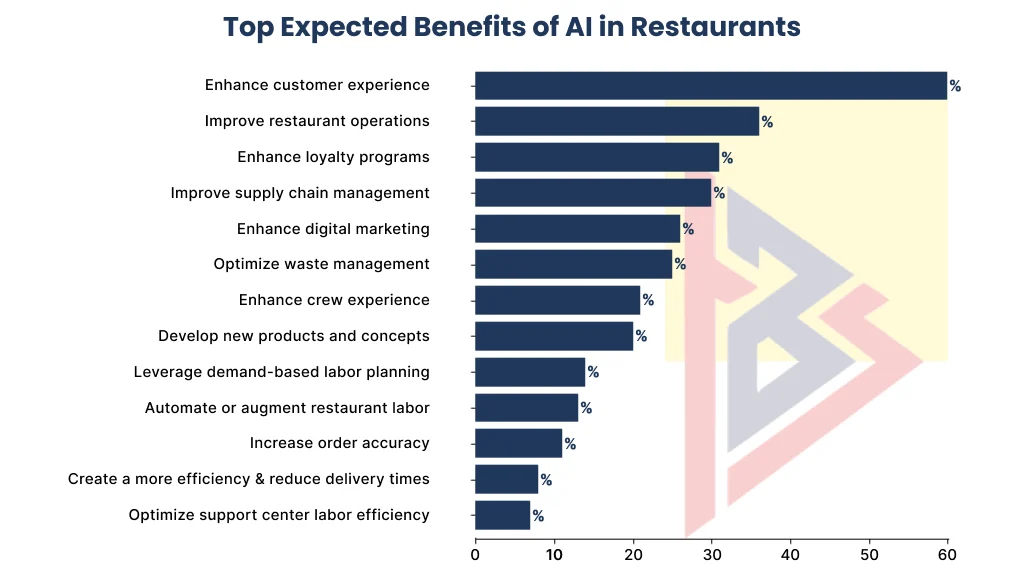
Restaurants have to do more with less. They have to deal with the cost of paying workers going up, making less money, and customers expecting more at the same time. That is why Artificial Intelligence comes in. It helps them respond faster, reduce work, and make better decisions every day in areas like customer experience and managing inventory, which Deloitte found are already areas where AI is being used a lot in the industry.
This change is significant because it is no longer an idea. Restaurants use AI to improve their service by making good decisions about staff forecasting accurately and reducing waste. Restaurants have advantages, such as efficiency, consistent customer service, and effective cost management.
Top AI Use Cases in Restaurants that Improve Efficiency and Guest Experience
The most valuable AI applications for restaurants are usually the ones that solve everyday pressure points, not the ones that look the most futuristic. Currently, restaurants are getting the strongest results from AI in customer experience, inventory management, loyalty, and operational planning.
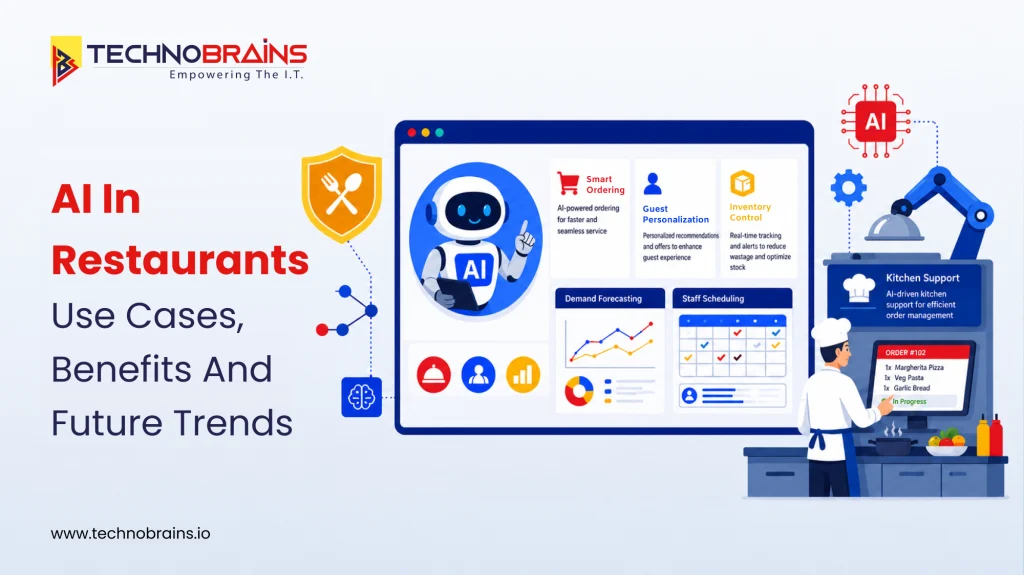
Smart Ordering
AI is helping restaurants handle orders more smoothly across calls, kiosks, apps, and online platforms. It reduces missed orders, cuts down wait times, and makes the ordering process easier for both guests and staff.
Guest Personalization
Restaurants are using AI to recommend menu items, send more relevant offers, and build loyalty programs around actual customer behavior. It makes the experience feel more personal without creating extra manual work.
Inventory Control
This field is one of the most practical areas of adoption. AI for restaurant inventory management helps operators track stock better, understand usage patterns, and order more accurately, which can make a real difference in food cost control.
Demand Forecasting
AI can analyze past sales, timing trends, and external factors to more accurately predict demand. That helps restaurants prep better, avoid overproduction, and make smarter decisions during busy and slow periods.
Staff Scheduling
Better forecasting also leads to better scheduling. AI for restaurant staff scheduling helps managers align labour with actual demand, which means fewer gaps during rush hours and less overstaffing when traffic is low.
Kitchen Support
AI is also starting to support food prep, consistency, and safety in the kitchen. From monitoring workflows to reducing avoidable errors, it helps restaurants keep operations tighter without losing control of quality.
AI for Restaurant Ordering, Reservations, and Customer Support Automation
Ordering that feels easier
This is one of the most practical areas where AI is already helping restaurants. It can manage phone orders, digital orders, and self-service ordering more smoothly, which helps reduce missed calls, improve accuracy, and keep service moving during busy hours. It is also one of the clearest areas where strong AI development services can create real value across customer touchpoints and backend systems.
Reservations without the back-and-forth
AI is also making reservation management much easier. Restaurants can use AI to manage reservations, respond to common queries, and remain available around the clock, rather than relying entirely on staff to answer every call or handle repetitive booking questions. That is why AI for restaurant ordering and reservations is becoming such a useful use case for operators who want less friction without losing the personal feel.
Support that stays responsive
Customer support now goes far beyond answering calls at the front desk. Guests expect quick responses across channels, whether they are asking about menu items, allergy information, reservation changes, or order updates. That is where AI solutions for restaurants become genuinely helpful. They do not replace the hospitality system, but they do help restaurants stay responsive when teams are busy and stretched.
AI for Restaurant Inventory Management, Demand Forecasting, and Food Waste Reduction
Smarter inventory control
AI helps the staff keep track of their stock accurately, see what is selling faster, and avoid buying too much of something they do not really need. It is useful for people who run restaurants and want to control food costs without having to do a lot of work.
Better demand planning
Restaurants can also plan better with AI. Instead of just guessing, they can look at sales patterns and demand to get ready for busy and slow times. This is where AI makes a difference because when restaurants plan better, they can prepare better, buy better, and have fewer last-minute problems.
Less food waste
When restaurants get better at managing their inventory and forecasting, the food waste naturally reduces. Restaurants can prepare carefully, buy more wisely, and avoid throwing away ingredients they never needed in the first place.
How AI Helps Restaurants Personalize the Guest Experience at Scale
AI helps restaurants give their guests a personal experience. One of the reasons restaurants are using AI is that guests want to feel like they are getting a personal experience.
They want offers that are relevant to them, better recommendations, and interactions that feel thoughtful instead of generic. That is why a lot of the practical uses of AI are about understanding what customers like and making the experience feel more tailored to them.
The good thing is that using AI does not have to make the service feel robotic. It can help restaurants give their guests personalized loyalty offers, menu suggestions, and digital interactions that still feel smooth and natural.
How AI Improves Restaurant Decision-Making, Forecasting, and Daily Operations
One of the biggest strengths of AI is that it helps restaurants make better decisions before small problems turn into expensive ones. Instead of reacting late, teams can spot patterns earlier, plan with more confidence, and run daily operations with less guesswork. That is a big reason why AI solutions for restaurants are becoming more valuable across forecasting, reporting, and operational planning. Restaurants are already seeing economic value from AI in customer experience and inventory.
- It helps managers read sales trends faster and make better day-to-day calls.
- It improves planning by turning historical data into clearer demand signals.
- It reduces guesswork around prep, purchasing, and shift planning.
- It gives operators better visibility of what is working and what needs attention.
- It enables quicker decision-making during peak times, preventing teams from having to respond after the damage has occurred.
That is why this part of AI in restaurants is so useful. It is not just about automation. It is about helping operators stay ahead of demand, improve consistency, and run a more controlled business every day. In practical terms, this is where some of the strongest benefits of AI in restaurants start to show up, especially for teams trying to manage pressure without complicating operations.
How AI Works in Restaurant Systems: From Data to Decisions
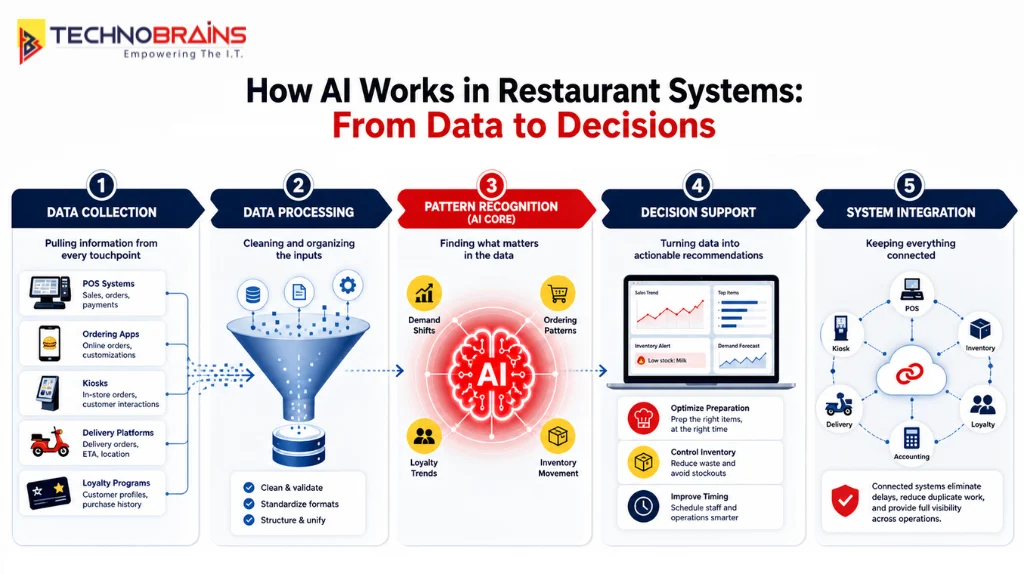
Most restaurant systems don’t operate from a single tool. The system receives orders through POS systems and applications, kiosks, and delivery platforms. AI connects multiple systems that hold inventory and customer information and operational data to enable teams to make quicker and better decisions.
Data Collection: Pulling Information From Every Touchpoint
The process starts by gathering data from the systems restaurants already use every day. That can include POS platforms, ordering tools, reservation software, inventory systems, and loyalty programs. This gives AI solutions for restaurants the context they need to work in a useful way.
Data Processing: Cleaning and Organizing the Inputs
Raw restaurant data is often dirty. Different tools store information in different formats, and not everything lines up automatically. Before anything useful happens, the system needs to clean, sort, and structure the data so it can actually support decisions.
Pattern Recognition: Finding What Matters
After employees complete organising the data, artificial intelligence begins searching for business-critical patterns. The system detects changes in demand and customer ordering patterns, customer loyalty patterns, and product inventory movements, which teams will overlook during their peak operational times.
Decision Support: Turning Data Into Action
The real value of those insights appears when they transform into actionable recommendations. The system provides restaurants with more than dashboard numerical displays because it enables them to optimize their preparation processes, timing operations, and inventory control.
System Integration: Keeping Everything Connected
This only works well when the tools behind it are properly connected. That is where strong custom software development becomes important, because disconnected systems create delays, duplicate work, and poor visibility across operations.
How AI Improves Revenue and ROI in Restaurants
The business value of AI usually does not come from one dramatic change. It comes from small improvements across ordering, operations, forecasting, and guest experience that add up over time.
- Higher order value
- Recommends relevant add-ons and combos at the right moment.
- Makes promotions feel more targeted, not random.
- Supports stronger upselling across digital channels.
- Lower operating waste
- Improves stock planning and reduces over-ordering.
- Helps cut unnecessary prep during slower periods.
- Supports AI for food waste reduction in restaurants in a measurable way.
- Better labor efficiency
- Helps managers plan shifts around real demand patterns.
- Reduces overstaffing and understaffing during key hours.
- Improves day-to-day output without adding more manual work.
- Stronger repeat business
- Makes loyalty offers more relevant to guest behavior.
- Improves service consistency across touchpoints.
- Turns better experiences into more repeat visits.
Common Challenges and How to Overcome Them
Artificial Intelligence can generate business value for the restaurant, but its implementation often faces challenges in the restaurant. Most organizations face challenges because of their readiness to adopt new technologies, which creates more operational obstacles than the actual technology itself in the restaurant.
Unclear use cases
Many restaurants try to apply AI broadly at the start. It usually works better when the focus stays on one problem that is straightforward to test and measure at the restaurant.
Messy data
Artificial intelligence requires both clean data and complete data to function properly in a restaurant. When systems lack connection or face consistency problems, their outputs become less reliable and more difficult to trust at the restaurant.
Team resistance
Staff members at the restaurant often hesitate when they lack knowledge about the advantages of artificial intelligence. When organizations use AI as technology, employees show higher adoption rates in the restaurant.
Integration issues
Even useful tools can fall short if they do not fit into the restaurant’s existing systems. The implementation of AI in restaurants requires this element because it reduces complexity within the restaurant.
Cost concerns
Some operators expect returns from the start at the restaurant. The value of operations increases gradually through improved planning and operational efficiency at the restaurant.
Governance and control
Restaurants also need procedures for handling privacy monitoring, accuracy, and maintaining control in the restaurant. Artificial intelligence should support business decisions that maintain trust with both customers and the organization at the restaurant.
Conclusion
Artificial intelligence is transforming how the restaurant industry manages operations, customer service, and growth. The technology helps to decrease waste and enhance customer satisfaction, and streamline daily operational activities when it receives proper application within specific business functions.
TechnoBrains, a leading restaurant app development company, helps businesses build digital solutions that are practical, scalable, and aligned with real restaurant needs. The process begins with planning and design work and continues through development and support to create systems that enhance both the guest experience and operational efficiency.
For restaurants looking to stay competitive, they should adopt technology only when it helps their business because this approach will help them maintain their competitive position. The organization needs to create intelligent systems that enable better service delivery and enhance operational efficiency.
Frequently Asked Questions
The key benefits of AI implementation in restaurants result from improved serving speed, enhanced forecasting abilities, decreased operational waste, and increased efficiency in business activities.
Restaurants apply AI technology to perform essential functions, which include ordering and reservations, customer support, inventory management, and loyalty programs.
No, it doesn’t. Restaurants use AI to automate tasks that occur repeatedly while enhancing their ability to make quick decisions about their operations. The organization aims to enhance team performance through its technological solutions.
The best way to start is with one clear use case that solves a real problem, like ordering, forecasting, or guest management.
Restaurants will experience AI technology through enhanced system connectivity, predictive capabilities, and operational tools that aid daily business activities. The most significant advantages for businesses will come from tools that enhance their planning capabilities, personalization methods, and operational efficiency at work.