The steps of designing hospitality software follow a strategy aimed at creating a solution that will enhance customer experience and make operations seamless for any hospitality business. From setting the goals to maintenance, it goes through easy-to-understand steps. We break down each step in layman’s terms to create clarity for both tech-savvy and nontechnical readers below.
Detailed Development Process:
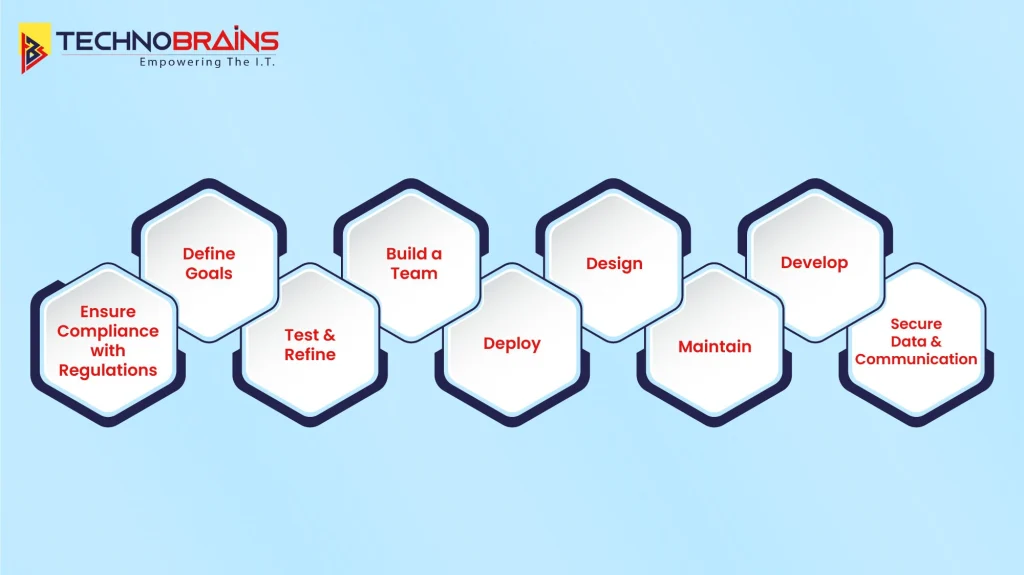
Here is how the development of successful hospitality software takes place:
1. Define Goals
The first step of hospitality software development is to define clear and achievable goals. This would involve making sure that one understands specific problems and challenges unique to the hospitality business. For example, are you looking to enhance booking efficiency, improve the customer experience, or smooth back-end operations? Effectively defined goals help shape the project and provide a roadmap for the whole development process.
Due to this, the discussion will place more emphasis on the nitty and gritty and will raise loads of pain points in need of improvement from people who are going to use it: hotel managers, staff, and guests. Setting SMART goals—Specific, Measurable, Achievable, Relevant, Time-bound—maintains focus on which way the project is moving towards, setting bases for tracking progress in terms of those goals.
Read Also, Ultimate Guide to Hospitality Software Development in 2024
2. Build a Team
For hospitality software, one major consideration for any hospitality project is including team members with working knowledge of the hospitality world. Hospitality software developed by experts knowing what the sector needs brings out hospitality software attuned to users’ needs. Moreover, this could result in more creative solutions as a result of varied perspectives of people.
Key Roles
- Project Manager: For managing the whole pipeline and ensuring everything stays on track and meets deadlines.
- Business Analyst: These experts will care that the business needs are translated into technical requirements.
- UX/UI Designer: You need a designer who can take care of the designing part and ensure user-friendliness.
- Developers: For writing the code and developing the base of the software.
- QA Testers: Testing the software and fixing bugs.
3. Design
The design phase is defining a blueprint of the software. This utilizes the visual design involved as well as the general architecture.
User Interface (UI) Design
The UI design should be appealing and very interactive. Wireframe and draw up mockups to understand the layout and flow of the entire application. Customer interface wireframes designed with tools like Sketch or Figma require intuition in their design and the look and feel of the branding for the hospitality business.
User Experience (UX) Design
UX design always has an eye for the user journey. Your software should be so fluid and enjoyable to use. This may include smoothing registration, fast access to information for guests, and ease of handling for staff with all tools at their fingertips.
4. Develop
The design is ready, so now it’s time to start building the software. The development phase involves writing down the code and creating the functionality of the application.
Coding
Developers start writing code as per the design and technical specifications. When coding, changes to the codebase are maintained via version control systems like Git. Adhere to best practices during coding, such as writing clean and modular code, and using appropriate and consistent naming conventions.
Integration
Integrated different parts of software during development. Connect the front-end User Interface with the Back-End Server, integrate Third-Party services such as Payment Gateways, and ensure free movement of the data between any sections or critical filters at its end.
5. Secure Data and Communication
Security, from that perspective, is indeed a very critical aspect of software development for hospitality and, in general, can be broadly categorized into the following three major classes:
Data Encryption
Implement data encryption to safeguard sensitive information. Use SSL/TLS for the encryption of data being transferred over the internet and encrypt algorithms to secure data in databases.
Regular Security Audits
Run regular security audits to detect vulnerabilities and fix them. Security testing can be done with tools like OWASP ZAP or Burp Suite to identify issues before the software is exposed to an attack.
6. Ensure Compliance with Regulations
The hospitality software must meet multiple regulations to safeguard user data and adopt ethical practices.
GDPR and CCPA
Ensure your software conforms to GDPR and CCPA because most of these records belong to users—namely, European Union or California users. You need to have their consent to collect and obtain data and offer the ability to access or delete data kept securely.
PCI DSS
Comply with PCI DSS standards if the software processes credit card payments. Securing payment data, regularly testing security systems, and maintaining a secure network is extremely important in this case.
7. Test and Refine
Before deploying the software, thorough testing is essential to ensure it works correctly and meets user needs.
Functional Testing
Test each of the features to compare results to the aspired output on individual components of the program (unit testing), or see how these components work collectively (integration testing), or on the whole system (system testing).
User Acceptance Testing (UAT)
Test each of the features to compare results to the aspired output on individual components of the program (unit testing), or see how these components work collectively (integration testing), or on the whole system (system testing).
8. Deploy
In this stage the software should be well-tested and fine-tuned, now it’s time to deploy it. The stage is crucial as it involves the first impact as well as feedback of the developed hospitality software.
Deployment Strategy
Choose a deployment strategy that ideally causes little downtime and, thus, interference. This may involve setting up the software in stages, blue-green deployment, or canary releases whereby checks are conducted on software with a live but small group of users before it is totally completed.
Monitoring
Set up monitoring in order to make analytics regarding the performance of and the way the software is used. Employ tools, for example, New Relic or Datadog, in monitoring the metrics, amongst others, the time of response, error, and user activity.
9. Maintain
Ongoing maintenance is just as important after deployment to make sure the software remains up and working.
Regular Updates
Release regular update packs containing bug fixes, additional exciting features, and performance improvements. Use the feedback from users to prioritize the updates in such a way that the software continues to meet their needs.
Support
Provide support to users, helping them with any issues they encounter. A dedicated support team can resolve problems quickly and ensure a positive user experience.
Read Also, Different Types of Hospitality Software You Must Know About
Conclusion
Now you know what it takes to develop a great hospitality software. With this detailed process at your disposal, you can build a great and reliable hospitality software development process that can ease the work’ and processing for hospitality-related businesses. In case you are in search of reliable software development that can ease your hospitality development process then consider TechnoBrains at your service.
Still stuck with questions? Contact us today!