Get 40 Hours Free Developer Trial
Test Our Developers for 40 Hours at No Cost - Start Your Free Trial →
How Agentic AI Coding Tools are Reshaping Software Development
Software teams are not using AI the way they were a year ago. The shift now is toward agentic AI that can take a goal, work through multiple steps, and move tasks forward instead of only suggesting code. SonarSource’s 2026 report found that 72% of developers who have tried AI coding tools now use them […]
17 Mar, 2026
How Agentic AI Coding Tools are Reshaping Software Development
Software teams are not using AI the way they were a year ago. The shift now is toward agentic AI that can take a goal, work through multiple steps, and move tasks forward instead of only suggesting code. SonarSource’s 2026 report found that 72% of developers who have tried AI coding tools now use them every day, indicating how quickly these tools have moved into real-world development workflows.
That shift is also changing the conversation around how agentic AI is changing software development. Teams are starting to use AI coding agents for implementation, testing, debugging, and other repetitive work that slows down delivery. The appeal is not just speed. It is the ability to keep work moving with fewer manual back-and-forths throughout the software lifecycle.
The bigger question now is not whether these tools are useful. It is how to use agentic AI coding tools for enterprise software development in a way that improves output without creating new quality or workflow issues later. That is where this topic becomes more practical, because the real value is in understanding where these tools fit, how they work, and how teams can use them well.
What are Agentic AI Tools?
Agentic AI coding tools are built to do more than answer prompts or suggest snippets. They can take a broader development goal, break it into steps, work across files, run commands, and keep moving until the task is actually pushed forward. Google Cloud describes agentic coding as a development approach where autonomous AI agents plan, write, test, and modify code with minimal human intervention.
What makes them different is how they operate after the first response. Instead of stopping at output, they can inspect the codebase, make edits, run checks, and adjust based on what happens next. Claude Code, for example, is built to read a codebase, edit files, run commands, and work through problems more like an active execution layer than a passive assistant. That is the real shift behind what is agentic coding today: AI moving from suggestion mode into controlled execution inside the software workflow.
Agentic AI Coding Tools vs Traditional AI Coding Assistants
Traditional AI coding assistants primarily support developers with suggestions, code completion, and prompt-based guidance. Agentic AI coding tools operate at a broader execution level, handling multi-step tasks across files, tools, and validation workflows with less manual intervention.
| Traditional AI Coding Assistants | Agentic AI Coding Tools | |
|---|---|---|
| Core role | Suggest code, explain logic, answer prompts | Take a goal and actively work toward completing it |
| How they respond | Wait for step-by-step input from the developer | Break work into steps and move through them with less manual guidance |
| Scope of work | Usually focused on one file, one snippet, or one question at a time | Can work across files, commands, tests, and related tasks in sequence |
| Workflow style | Reactive support inside the coding process | Goal-driven execution inside the coding process |
| Tool use | Primarily generates output for the developer to use | Can inspect code, edit files, run commands, and verify results |
| Iteration | Usually stops after giving a response | Can adjust its work based on test output, errors, or new context |
| Best fit | Autocomplete, quick fixes, explanations, and brainstorming | Multi-step implementation, debugging, refactoring, and task execution |
| Human role | Direct most of the work manually | Set goals, review outputs, and keep guardrails in place |
How These Tools Fit into the Software Development Lifecycle
AI coding tools are moving beyond code completion. Teams are starting to use them across planning, implementation, testing, and repository workflows as part of the delivery process, not just inside the editor.
Planning and architecture
- Agents can turn a high-level request into a structured plan by analyzing the codebase, identifying dependencies, and outlining the likely implementation path.
- This helps teams scope work faster and understand which parts of the system may be affected before changes begin.
Coding and implementation
- This is one of the most established use cases for agentic coding tools. They can update multiple files, implement scoped changes, and handle routine development tasks with less manual prompting.
- The value comes from task execution across the codebase, not just faster code generation in a single file.
Testing and debugging
- A key part of how agentic AI coding tools work is the feedback loop. They can run tests, inspect failures, revise code, and retry based on the result.
- This makes them useful for repetitive debugging, regression checks, and expanding test coverage with less developer effort.
Maintenance and modernization
- These tools are also being used for technical debt reduction, dependency updates, and legacy code improvements across active repositories.
- This becomes even more effective when paired with AI integration services that connect coding agents with internal tools, repositories, and validation workflows.
Review and governance
- Final ownership still stays with the engineering team. Agentic workflows support execution, but review, approval, and security controls remain essential.
- In practice, these tools work best when they operate inside clear boundaries rather than replacing engineering judgment.
Top Agentic AI Coding Tools to Know in 2026
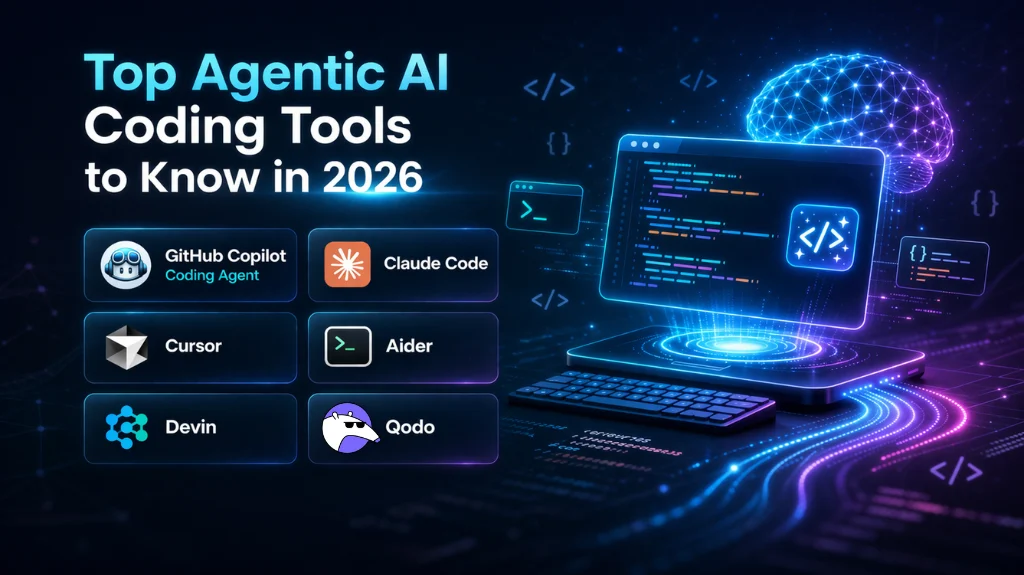
The market for agentic AI coding tools is becoming more specialized. Some tools are built for repository execution, some for terminal workflows, and some for testing and review. The strongest options are the ones that fit real engineering processes and broader AI consulting services’ needs, not just faster code generation.
GitHub Copilot
GitHub Copilot is designed for scoped repository tasks such as bug fixes, refactoring, documentation updates, and logging improvements. It fits teams that already work heavily inside GitHub and want agentic execution within a familiar workflow.
Claude Code
Claude Code is built for engineers who want terminal-first execution with strong repository awareness. It can read a codebase, edit files, run commands, and support multi-step development tasks with less manual prompting.
Cursor
Cursor combines editor-based development with agent-style execution features such as background task handling and review support. It is a strong fit for teams that want coding, bug detection, and pull request support in one environment.

Aider
Aider is a practical option for developers who prefer Git-based, terminal-driven workflows. Its strength is controlled, reviewable code changes rather than high-autonomy execution.
Devin
Devin is positioned at the higher-autonomy end of the market. It is most relevant for teams evaluating how far they want to push task execution while still maintaining review and governance.
Qodo
Qodo is more focused on testing, code quality, and review workflows than broad implementation. It is useful for teams that want stronger validation around AI-generated output and a more quality-centered workflow.
Need the right agentic AI setup for your software team? We help businesses design and implement practical AI agent workflows that fit real development processes.
Talk to Our Experts!
Benefits of Agentic AI Tools for Software Teams
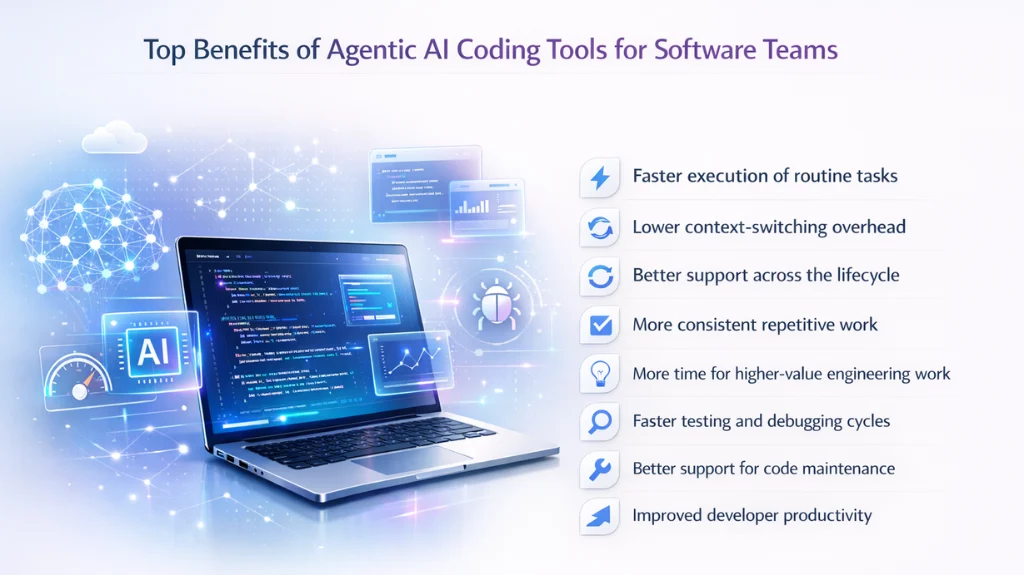
The main benefits of agentic AI coding tools come from multi-step execution. These tools can plan, edit files, run checks, and iterate across tasks instead of stopping at a single response. Google, GitHub, and Anthropic all frame modern coding agents around execution, repository awareness, and validation.
Faster execution of routine tasks
AI coding agents can handle scoped work such as bug fixes, refactoring, test updates, and documentation changes with less manual prompting. This helps teams move common engineering tasks faster.
Lower context-switching overhead
These tools can inspect code, edit files, and run commands in one flow. That reduces the manual back-and-forth that developers usually manage across tools and steps.
Better support across the lifecycle
They are useful beyond implementation, including planning, testing, debugging, and maintenance. That gives teams broader value than prompt-only coding support.
More consistent handling of repetitive work
Agentic systems are effective on repeatable tasks such as applying structured changes across files or improving test coverage. That consistency is especially useful in larger codebases.
More developer time for higher-value work
By taking on routine execution, these tools allow engineers to spend more time on review, architecture, and technical decisions. This is where generative AI solutions start to create practical value inside software teams.
Use Cases of Agentic AI Coding Tools in Software Development
The most effective use cases for agentic AI coding tools for software development are tasks with clear scope, repeatable steps, and reviewable output. In practice, teams are using them most often for feature work, bug fixing, testing, refactoring, and codebase exploration.
Feature implementation
Teams use agentic coding tools to turn a scoped requirement into working code across multiple files. GitHub documents issue-based task execution and pull request creation, while VS Code positions Copilot agents around implementing features across projects.
Bug fixing and debugging
This is one of the most practical uses for AI coding agents. Claude Code’s official workflows explicitly cover debugging, and Anthropic case material highlights troubleshooting infrastructure and engineering issues with agent support.
Test generation and validation
Agentic tools are increasingly used to write tests, improve coverage, run checks, and retry after failures. GitHub and Claude both document testing as a core workflow, which makes this a strong fit for teams that want faster validation loops.
Refactoring and technical debt reduction
Refactoring is a common use case because these tools can update related files, preserve task context, and support structured cleanup work. GitHub documents refactoring directly, and Claude includes it in everyday development workflows.
Codebase exploration and onboarding
Agentic tools are useful for understanding unfamiliar repositories, tracing logic, and surfacing the files involved in a task. Claude’s common workflows explicitly include understanding new codebases, which makes this valuable for onboarding and handoffs.
Legacy modernization
Google and other enterprise sources increasingly position agentic workflows around modernization, including code conversion, legacy improvement, and business logic migration. This is also where some teams look to hire AI developers when internal capacity is limited.
Risks and Limitations of Agentic AI Coding Tools
The biggest risk with agentic AI coding tools is that they can produce code that looks correct before it is actually secure, reliable, or complete. GitHub’s own guidance states that coding agents can generate syntactically correct output that may still be insecure, which is why review and secure coding practices remain necessary. Apiiro also frames AI coding agents as an expanded attack surface because they can introduce vulnerabilities, unvetted dependencies, business logic flaws, and audit gaps if teams let them operate without clear controls.
The main limitation is not raw capability, but context and control. Anthropic’s Claude Code documentation notes that teams need to understand model constraints, define requirements clearly, and manage operating costs and boundaries as usage scales. In practice, that means agentic workflows work best when tasks are scoped, permissions are limited, and validation stays inside the engineering process.
Best Practices for Adopting Agentic AI Coding Tools
- Start small: Agentic AI coding tools perform better when the scope is clear, the output is easy to review, and the task does not affect critical production logic first.
- Set context: Repository rules, coding standards, architecture notes, and task boundaries improve output quality and reduce avoidable rework.
- Keep review: Even strong best practices for agentic coding workflows still depend on engineers to validate logic, security, and edge-case behavior before merge.
- Limit access: Agents should work inside controlled environments with clear boundaries around file changes, commands, dependencies, and deployment actions.
- Build process: Teams usually get better results when agent rollout is tied to review rules, testing gates, and broader custom AI development priorities instead of ad hoc usage.
How Agentic AI Coding Tools are Changing Developer Roles
Agentic AI coding tools are shifting developers away from routine execution and toward task definition, review, and validation. As agents take on more implementation, debugging, and testing work, developers are spending more time guiding the task, checking outputs, and making sure changes align with system requirements.
This also makes workflow discipline more important. Teams need stronger review habits, clearer repository standards, and better validation before merge because the developer’s role is moving from writing every change manually to managing quality and decision-making around AI-assisted execution.
The Future of Software Development with Agentic AI and How TechnoBrains Helps Teams Adopt it
Software development is moving toward more agent-led execution and more human-led oversight. As these tools improve, teams will spend less time on repetitive implementation and more time on planning, review, and decision-making.
This is where the company helps teams move from experimentation to practical adoption. As an agentic AI development company, we design agent workflows that fit real engineering processes, not just isolated tool usage.
Our focus is on implementation, integration, and control. That includes helping teams apply agentic workflows in a way that supports delivery, quality, and long-term maintainability.
Ready to adopt agentic AI in your development workflow? Connect with our team to plan, build, and integrate agentic AI solutions for your software environment.
Contact Us Today!
FAQs
How are agentic AI coding tools different from standard coding assistants?
Standard assistants mainly respond to prompts with suggestions or completions. Agentic tools can take a broader task, break it into steps, and keep working until there is a result to review.
Are agentic AI coding tools best for all development work?
No. They work best on a scope. They are less reliable when requirements are vague or the task involves sensitive business logic without strong oversight.
What skills matter most when teams adopt coding agents?
The most important skills are task framing, code review, architecture awareness, and validation discipline. As agents handle more execution, developers need to be stronger at setting boundaries and checking outcomes.
What makes agentic coding risky in enterprise environments?
It involves insecure code, together with weak dependency choices, compliance gaps, and the implementation of changes that remain untested at their current state.
How should teams start using agentic AI coding tools?
Start with narrow workflows, clear repository rules, and strong review gates. Teams usually get better results when agent use is introduced gradually inside a controlled AI software development process rather than rolled out broadly from day one.