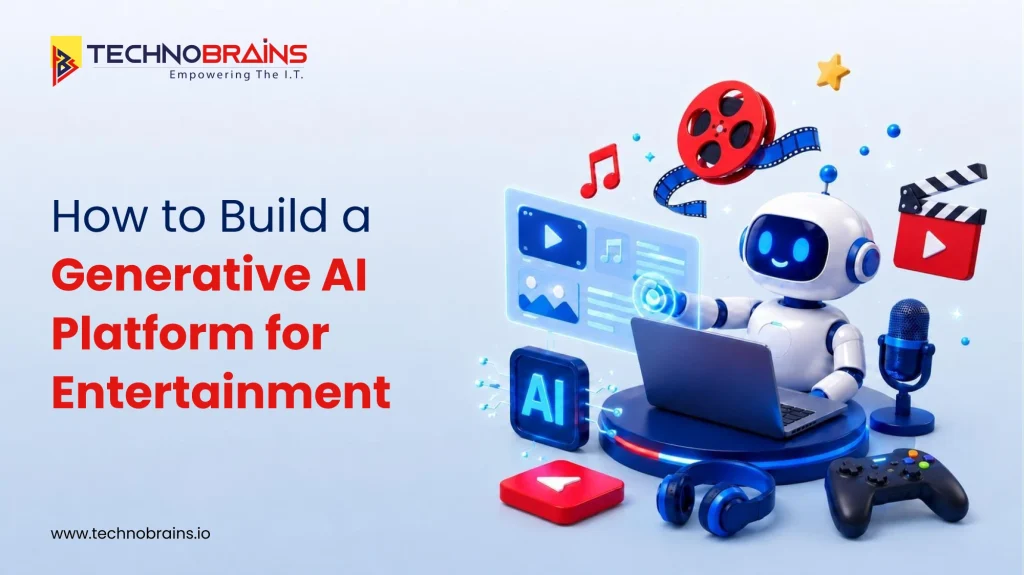
The entertainment industry is changing in a way. From how content is made to how users watch it, generative AI is changing everything. Companies today are not just trying out AI; they are investing in AI platforms to deliver faster, more personalized, and engaging user experiences.
This shift is even clearer in 2026. Deloitte highlights the growing wave of AI-generated content across platforms. At the same time, Grand View Research estimates that the global AI in media and entertainment market reached $33.68 billion and will continue to grow through 2030.
Whether it’s streaming services, gaming systems, or digital content studios, companies are figuring out how to build generative AI platforms that can make more creative content, automate production, and improve user engagement. This guide explains what it takes to design, develop, and grow an AI-powered entertainment platform in 2026.
AI in Entertainment: Market Trends 2026
The impact of AI in the media and entertainment industry has gone beyond simple automation. Today, AI platforms are being used to create videos, music, scripts, and interactive experiences on a large scale.
- A major reason for this shift is the growing demand for content. Users want platforms to deliver content that fits their preferences, and generative AI enables real-time content experiences.
- At the time, content production is becoming faster and cheaper. Businesses in the entertainment industry are adopting generative AI solutions to automate tasks such as editing, scripting, and design.
With the rise of immersive gaming and interactive storytelling, companies are now focusing on developing generative AI platforms rather than standalone tools. Many are looking at how to build a generative AI platform for entertainment to gain better control over data, personalization, and monetization.
What is a Generative AI Entertainment Platform?
A Generative AI entertainment platform is an AI-powered system that enables media and entertainment companies to create, manage, personalize, and distribute digital content from a single platform. Instead of depending on multiple disconnected tools, businesses can use a centralized tool to streamline production workflows.
These platforms use technologies such as Large Language Models (LLMs), machine learning, computer vision, natural language processing (NLP), and generative AI models to create text, images, videos, music, voiceovers, and other digital assets. Additionally, it also analyzes user behavior to deliver personalized recommendations.
Unlike standalone AI applications that perform a single task, it focuses on building scalable, end-to-end ecosystems that support multiple business functions. As demand for personalized and on-demand entertainment continues to grow, businesses are investing in Generative AI solutions for the entertainment industry to accelerate content production, reduce operational costs, improve user engagement, and deliver richer digital experiences at scale.
Build Your Generative AI Entertainment Platform
Turn your idea into a scalable platform built for content creation, personalization, and growth. Get Started!
Top Use Cases of Generative AI in Entertainment Platforms
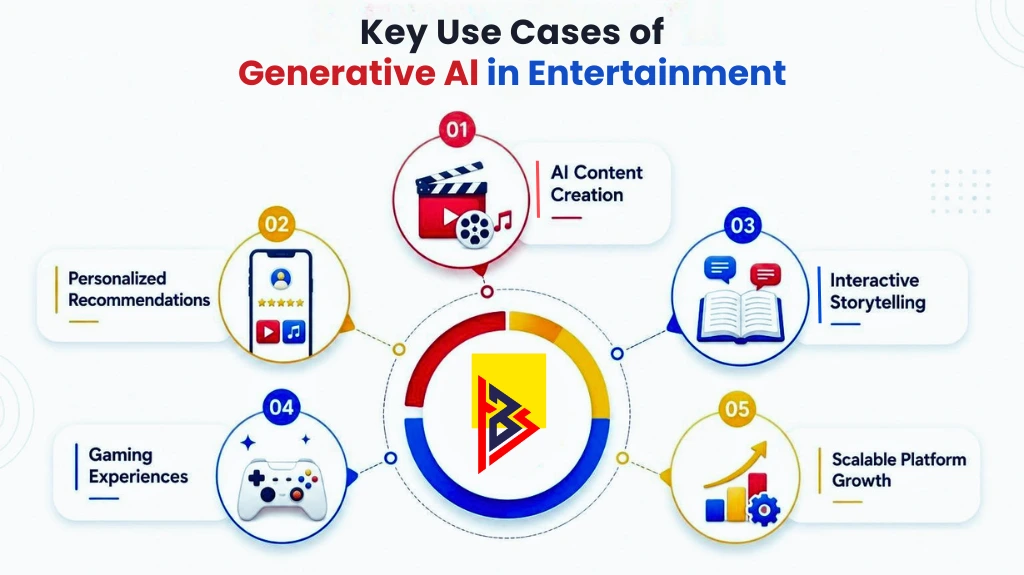
Generative AI is transforming the entertainment industry by helping businesses create content faster and deliver more personalized experiences. From streaming platforms and gaming companies to music providers and digital media businesses, organizations are adopting Generative AI solutions to improve production efficiency, increase audience engagement, and scale content delivery without compromising quality.
AI content creation
Content creation is one of the most valuable applications of Generative AI in entertainment. AI can assist with writing scripts, generating story ideas, creating images, producing music, editing videos, and developing marketing assets in a fraction of the time required by traditional production workflows. Rather than replacing creative teams, AI helps accelerate production and allows creators to focus on high-value creative work.
Personalized recommendation
Modern entertainment platforms rely on AI to understand user preferences and deliver personalized recommendations. Instead of showing the same type of content to everyone, platforms can better understand what each user enjoys and suggest content that feels more aligned with their interests. This improves user satisfaction, increases watch time, and strengthens long-term platform engagement.
Interactive storytelling
Generative AI enables entertainment companies to build dynamic storytelling experiences where narratives adapt based on user choices. Instead of following a fixed storyline, audiences can explore multiple story paths, interact with AI-generated characters, and experience personalized content that evolves throughout the journey.
Gaming experiences
The gaming industry is using AI to create smarter NPCs, procedurally generated environments, adaptive storylines, realistic dialogue, and personalized gameplay experiences. It also helps developers build larger and more interactive virtual worlds while reducing repetitive tasks for every player.
AI-powered media production
Generative AI is streamlining media production by automating tasks such as video editing, subtitle generation, voice synthesis, audio enhancement, scene generation, and content localization. These capabilities reduce production time, improve operational efficiency, and enable entertainment companies to publish high-quality content more quickly.
Scalable growth
As entertainment platforms expand, AI helps organizations scale content production and automate operational workflows without significantly increasing resources. Businesses can launch new features faster, manage larger libraries, support growing audiences, and continuously improve engagement through AI-driven automation and analytics.
Essential Features of a Scalable AI Entertainment Platform
A successful AI entertainment platform is more than a content generation tool. It requires a combination of AI capabilities, scalable infrastructure, personalization, automation, and seamless integrations to deliver engaging user experiences while supporting long-term business growth.
Multimodal Content Generation
A modern entertainment platform should support AI-powered generation of text, images, audio, video, and interactive media from a unified interface. This enables content teams to create diverse digital assets faster while maintaining consistency across multiple content formats.
AI-Powered Personalization Engine
Personalization is one of the biggest advantages. By analyzing user behavior, preferences, watch history, and engagement patterns, AI can deliver highly personalized experiences that improve user satisfaction and increase retention.
Intelligent Recommendation System
An advanced recommendation engine helps users discover relevant movies, music, games, articles, podcasts, or other digital content based on real-time behavior and historical interactions. AI-driven recommendations improve content discovery and overall platform engagement.
Content Editing & Automation Tools
Built-in AI editing tools simplify content refinement by assisting with script enhancement, image editing, subtitle generation, voice synchronization, metadata creation, and content optimization. Workflow automation reduces manual effort, accelerates production cycles, and improves operational efficiency.
Interactive Interfaces
Interactive capabilities such as AI chat assistants, virtual hosts, voice interactions, personalized storytelling, and adaptive content experiences create deeper audience engagement.
Scalable Infrastructure
A scalable infrastructure is essential for supporting AI model training, high-volume content generation, media processing, and growing user traffic. Cloud-native architecture, distributed computing, and secure APIs ensure the platform remains reliable as demand increases.
Analytics and Performance Insights
Built-in analytics allow businesses to monitor user engagement, content performance, recommendation accuracy, AI model effectiveness, and audience behavior. These insights help teams continuously optimize both content strategies and platform performance.
Technology Stack Required to Build a Generative AI Platform
Building a successful generative AI entertainment platform requires a robust technology stack that supports AI model training, content generation, personalization, scalability, and seamless integrations.
- AI Models: Use Large Language Models (LLMs) for text generation, diffusion models for image and video creation, speech or audio models, and music generation.
- Data Management: Build a reliable data pipeline for collecting, cleaning, labeling, storing, and managing text, image, audio, and video datasets.
- Cloud Infrastructure: Deploy the platform on a scalable cloud infrastructure with GPU acceleration to support AI model training, real-time inference, media processing, and high-volume content generation.
- Frontend Development: Create responsive mobile applications that allow users to generate, edit, and consume AI-powered content through interactive dashboards and interfaces.
- Backend Development: Manage user authentication, AI workflows, content generation, business logic, APIs, and platform operations.
- Databases & Storage: Use scalable databases for user and application data, along with object storage for AI-generated videos, images, audio files, and other digital assets.
- APIs & Third-Party Integrations: Integrate the platform with OTT services, Content Management Systems (CMS), Digital Asset Management (DAM) platforms, payment gateways, analytics tools, social media platforms, and external AI services to extend functionality.
- Security & Compliance: Implement encryption, role-based access control, secure APIs, copyright protection, audit logging, and compliance measures to protect user data and AI-generated content.
Step-by-Step Guide to Building a Generative AI Entertainment Platform
Building a generative AI entertainment platform requires a structured approach that combines AI development, data management, scalable architecture, and user-focused experiences. Following a step-by-step development process helps businesses create platforms:
Define Use Cases & Goals
Start by identifying the primary purpose of your platform. Determine whether the goal is AI-powered content creation, personalized recommendations, interactive storytelling, gaming experiences, automated media production, or a combination of multiple use cases.
Data Collection & Preparation
Next, collect relevant datasets such as text, images, videos, audio files, user behavior data, and content preferences. Clean, organize, and label the data to ensure AI models can generate accurate, relevant, and engaging content.
Select or Train AI Models
Choose AI models based on the requirements. LLMs can support text generation and conversational experiences, while diffusion models can generate images and videos, and audio models can create voice or music content.
Design Architecture
Create an architecture that supports AI processing, content generation, user management, storage, APIs, and third-party integrations. A scalable architecture ensures the platform can handle increasing users, larger content volumes, and complex AI workloads without performance issues.
Develop Core Features
Develop features such as AI content generation, personalization engines, recommendation systems, interactive interfaces, content editing tools, and analytics dashboards. Integrate AI models into the platform workflow to deliver automated and intelligent entertainment experiences.
Testing & Optimization
Conduct testing to evaluate platform performance, accuracy, security, usability, and content quality. Test different AI outputs, identify potential biases, optimize response quality, and improve the overall user experience before launch.
Deployment & Scaling
Finally, deploy the platform using secure cloud infrastructure and monitor system performance after launch. Implement auto-scaling, performance optimization, and continuous AI model improvements to support growing users and evolving entertainment requirements.
Need a Custom AI Platform for Entertainment?
Work with our team to design and develop a platform tailored to your users, content goals, and business model. Talk to Our Experts!
Monetization Strategies for AI-Powered Entertainment Platforms
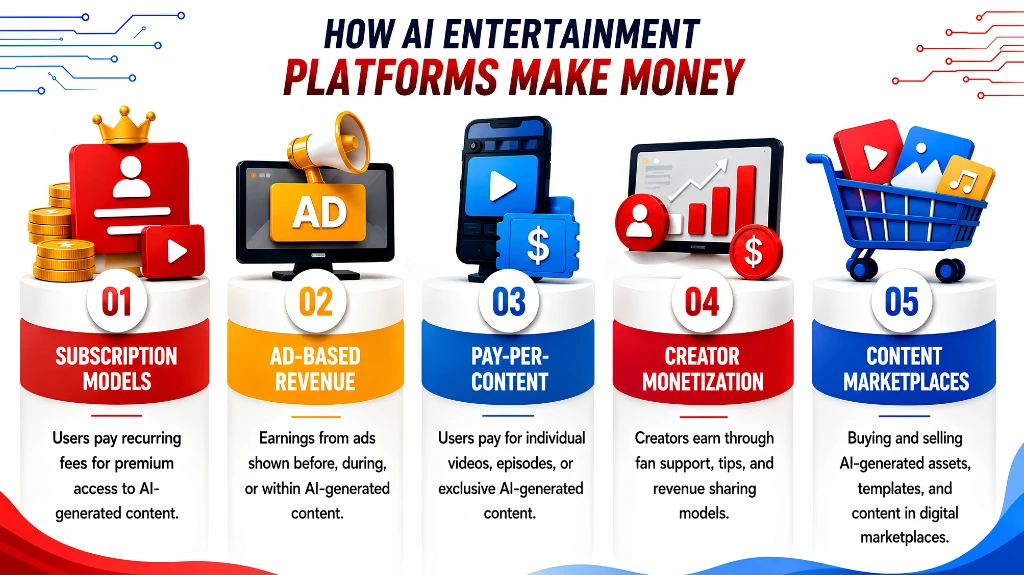
To make a generative AI platform for entertainment last long, businesses need clear plans on how to make money. A thought-out approach to generative AI platform development should include the following:
- Subscription Models: Offer extra access to content or features for a fee, which is a common way in AI-powered entertainment platforms.
- Ad-Based Revenue: Use ads powered by generative AI in entertainment to get more users engaged and make ads work better.
- Pay-Per-Content: Charge users for content like movies or games on your generative AI entertainment platform.
- Creator Monetization: Let creators earn money through AI-generated content using generative AI solutions for the entertainment industry and generative AI platforms.
- Content Marketplaces: Create places where users can buy and sell AI-generated assets, helping businesses build generative AI platforms with new ways to make money.
These strategies help ensure long-term growth for any AI entertainment platform and generative AI solutions.
Challenges, Risks, and Ethical Issues in Generative AI Entertainment
While generative AI is transforming the entertainment industry by accelerating content creation and personalization, it also has technical, legal, and ethical challenges that businesses need to consider during development.
One of the biggest challenges is determining ownership of AI-generated content. Organizations must ensure that training data, generated assets, and creative outputs comply with copyright laws and licensing requirements to minimize legal risks.
Generative AI can produce highly realistic images, videos, audio, and text, making it increasingly difficult to distinguish authentic content from AI-generated media. Platforms should implement content verification, watermarking, and moderation mechanisms to reduce misinformation and maintain user trust.
AI-powered entertainment platforms often process large volumes of user data to deliver personalized experiences. Businesses must implement robust security measures, encryption, access controls, and privacy policies while complying with regulations such as GDPR, CCPA, and other applicable data protection standards.
Clear governance policies are necessary to ensure AI is used responsibly. Organizations have to establish guidelines for content moderation, human oversight, model monitoring, transparency, and ethical AI usage to reduce potential risks and maintain accountability.
Conclusion
Generative AI is reshaping the entertainment industry by enabling businesses to create content faster, deliver highly personalized experiences, and automate creative workflows at scale. From AI-generated media and recommendations to interactive storytelling and immersive gaming, the opportunities continue to expand as the technology evolves.
However, building a successful generative AI entertainment platform requires more than integrating AI models. It demands the right technology stack, scalable architecture, responsible AI practices, robust security, and a clear understanding of user expectations. Organizations that combine innovation with strong governance will be better positioned to deliver engaging, reliable, and future-ready entertainment experiences.
At TechnoBrains, we help businesses design and develop custom generative AI solutions tailored to their business goals. From AI strategy and platform architecture to model integration, cloud deployment, and enterprise-scale development, our team delivers intelligent entertainment platforms built for long-term growth. Contact us today!
FAQs
Start by defining use cases, selecting the right models, and following a structured generative AI platform development process that includes design, development, and scaling.
Core features include content generation, personalization, recommendation systems, and integrations in AI-powered entertainment platforms.
The cost depends on features, infrastructure, and scale. Advanced generative AI solutions for the entertainment industry typically require higher investment.
Generative AI in entertainment is used for content creation, personalization, gaming, and immersive experiences.
Businesses invest in generative AI platforms for entertainment to improve efficiency, enhance user engagement, and create new monetization opportunities.