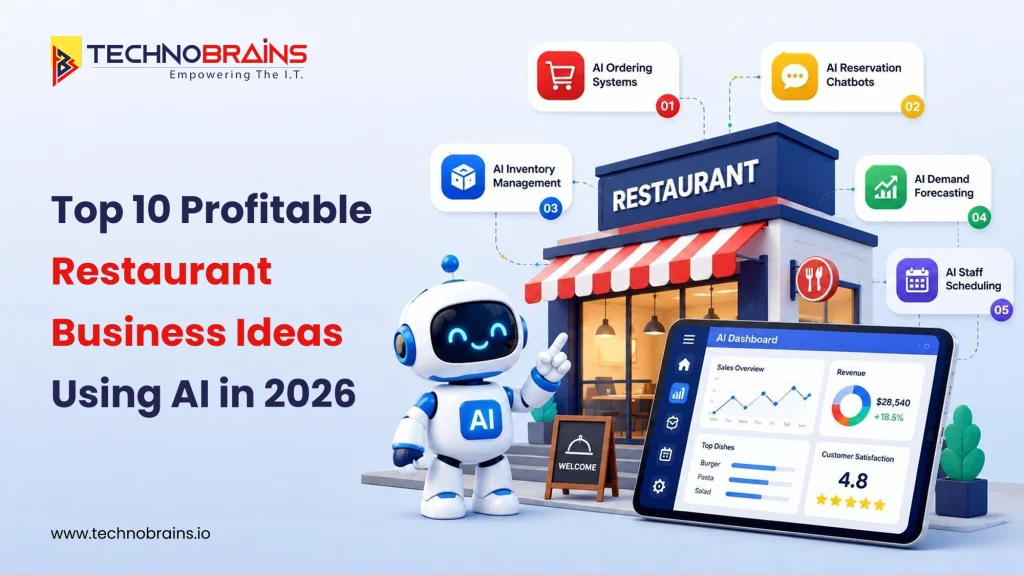
Restaurants are increasingly using artificial intelligence to solve practical operational challenges, from order management and demand forecasting to staff scheduling, inventory control, and customer engagement. As labour costs, food waste, and customer expectations continue to put pressure on restaurant operators, AI is becoming a practical tool for improving efficiency rather than simply a technology trend.
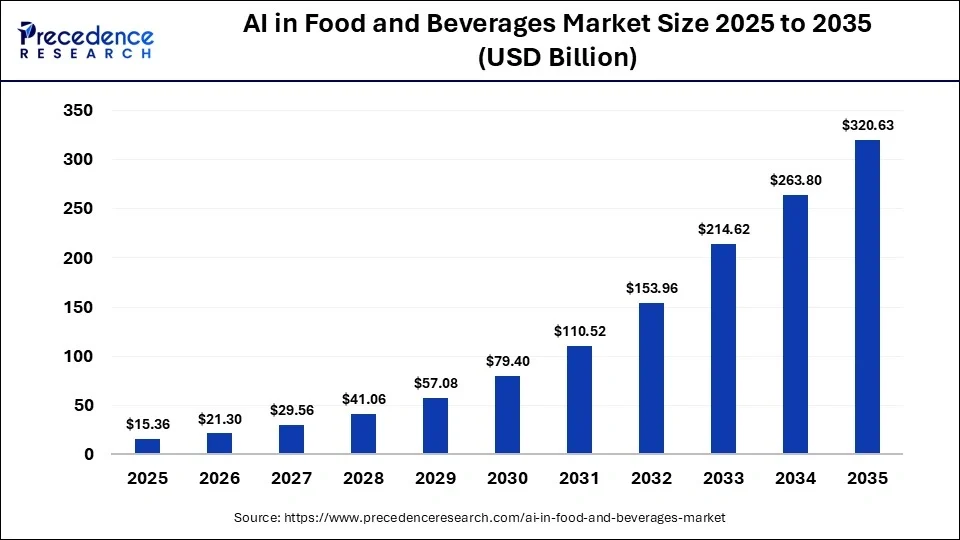
The opportunity is particularly interesting because restaurant operations generate large amounts of structured data through POS systems, online orders, reservations, inventory platforms, and customer interactions. The global AI in food and beverages market was valued at USD 15.36 billion in 2025 and is projected to grow at a 35.51% CAGR from 2026 to 2035.
In this guide, we explore 10 profitable ways restaurants can use AI in 2026 and beyond, the business problems each use case addresses, the technologies involved, and how restaurant owners can evaluate whether an AI investment is worth pursuing.
Build Smarter Restaurant Operations with AI
Ready to turn these ideas into real results? Let’s help you implement the right AI solution tailored to your restaurant. Get Started!
10 Profitable Restaurant Business Ideas Using AI
Restaurants are adopting artificial intelligence not simply to keep up with technology trends, but to solve practical challenges that affect service speed, operational efficiency, labour costs, customer satisfaction, and profitability. The most valuable AI applications are those that help restaurants automate repetitive tasks, make better decisions, and deliver more consistent customer experiences.
AI ordering systems for faster service and fewer order errors
AI-powered ordering systems can help restaurants manage orders across multiple channels, including phone, kiosks, drive-thrus, websites, and mobile apps. By understanding customer requests and automating parts of the ordering process, these systems can reduce manual work and improve order accuracy.
- Reduce order errors: AI can capture and process customer orders more consistently, particularly during busy periods.
- Handle higher order volumes: Automated ordering helps restaurants manage demand across multiple channels without placing additional pressure on staff.
- Improve the customer experience: Instant confirmations and smoother ordering workflows can reduce misunderstandings and unnecessary corrections.
AI chatbots for restaurant reservations and customer support
AI chatbots can automate common customer interactions, including table reservations, opening-hour enquiries, menu questions, and other frequently asked questions. This allows restaurant staff to focus on in-person service while customers receive faster responses.
- Automate reservations: Customers can request, modify, or cancel bookings without waiting for staff assistance.
- Answer common questions: Chatbots can provide quick responses about menus, locations, operating hours, and restaurant policies.
- Provide after-hours support: Customers can continue to receive basic assistance even when the restaurant is closed.
AI inventory management for smarter stock control
Inventory management is another area where AI can provide practical value. By analyzing inventory levels, historical usage, sales patterns, and other relevant data, AI-powered systems can help restaurant teams make more informed purchasing and stocking decisions.
- Reduce overstocking: Restaurants can use demand patterns to make more informed purchasing decisions and reduce unnecessary inventory.
- Identify fast- and slow-moving items: AI can highlight which ingredients are being used quickly and which remain in storage for longer periods.
- Improve reordering: Automated insights can help managers determine when and how much inventory should be reordered.
AI demand forecasting for better sales and staffing decisions
Demand forecasting helps restaurants predict expected customer volume by analyzing historical sales, seasonal patterns, busy periods, and other demand signals. Instead of relying entirely on intuition, managers can use these insights to prepare their operations more effectively.
- Prepare for busy periods: Restaurants can anticipate demand and prepare staff, ingredients, and resources in advance.
- Improve staffing decisions: Forecasts can help managers align staffing levels with expected customer volume.
- Support daily planning: Predictive insights can reduce guesswork and help teams make more informed operational decisions.
AI staff scheduling for lower labor costs and better shift planning
AI-powered scheduling tools can help restaurants create shifts based on expected demand, historical sales, employee availability, and operational requirements. This can make workforce planning more efficient while helping managers avoid unnecessary overstaffing.
- Match staffing with demand: Managers can schedule the right number of employees for expected customer volume.
- Reduce unnecessary labour costs: Better scheduling can help avoid excessive staffing during slower periods.
- Simplify shift planning: Automated scheduling can reduce the time managers spend creating and adjusting employee schedules.
AI menu engineering for higher profit margins
AI can help restaurants analyze menu performance by looking at sales data, customer preferences, pricing, and item profitability. These insights can help restaurant owners identify which dishes perform well and where menu changes may improve revenue.
- Identify high-performing dishes: AI can highlight popular and profitable menu items.
- Support pricing decisions: Sales and profitability data can help restaurants evaluate menu pricing more effectively.
- Improve upselling: Restaurants can recommend complementary or higher-margin items based on customer preferences and ordering patterns.
AI food waste reduction for more efficient restaurant operations
Food waste directly affects restaurant profitability, making waste reduction an important operational goal. AI can analyze sales patterns, inventory usage, and preparation data to help restaurants identify waste and improve food planning.
- Identify sources of waste: AI analytics can help managers pinpoint ingredients or processes that contribute to excessive waste.
- Improve food preparation: Demand insights can help teams prepare quantities that more closely match expected customer demand.
- Improve operational efficiency: Better planning can help restaurants reduce unnecessary waste while maintaining service quality.
AI kitchen automation for faster prep and smoother workflows
AI-powered technologies can support kitchen operations by helping restaurants coordinate orders, organize workflows, monitor preparation processes, and automate repetitive tasks. These capabilities can be particularly valuable during high-volume service periods.
- Improve preparation workflows: AI can help organize kitchen tasks according to order requirements and priorities.
- Coordinate teams: Better visibility into incoming orders can help kitchen staff coordinate their work more effectively.
- Maintain consistency: Automated workflows can help restaurants maintain more consistent processes during busy periods.
AI customer personalization for loyalty and repeat orders
AI can help restaurants understand customer preferences and use those insights to create more personalized experiences. Instead of providing identical offers to every customer, restaurants can use customer and ordering data to recommend relevant dishes, promotions, and experiences.
- Deliver personalized offers: Restaurants can provide promotions tailored to customer preferences and past orders.
- Encourage repeat purchases: Personalized recommendations can make it easier for customers to discover dishes they are likely to enjoy.
- Strengthen customer loyalty: More relevant interactions can help restaurants create stronger relationships with returning customers.
AI for cloud kitchens and multi-location restaurant growth
AI can also support restaurants that operate cloud kitchens or multiple locations. These businesses often manage large volumes of orders, inventory, staff, and operational data across different locations. AI can bring these processes together and provide better visibility into performance.
- Improve multi-location consistency: Centralized insights can help restaurant groups monitor operations across multiple locations.
- Manage high order volumes: AI-powered workflows can help cloud kitchens handle large numbers of orders more efficiently.
- Support business expansion: Data-driven insights can help businesses understand performance across locations and identify growth opportunities.
Upgrade Your Restaurant with Practical AI Solutions
From ordering to operations, we help restaurants build systems that actually work in real-world scenarios. Book a Free Consultation!
Key Benefits of AI in Restaurants for Efficiency, Cost Control, and Guest Experience
AI can help restaurants improve day-to-day operations by automating repetitive tasks, supporting better decision-making, and creating smoother customer experiences. From managing orders and staffing to reducing waste and personalizing customer interactions, the right AI solution can deliver value across multiple areas of restaurant operations.
- Faster Service: AI can streamline tasks such as order processing, reservations, and customer enquiries, helping restaurants respond more quickly and manage busy periods more efficiently.
- Better Accuracy: AI-powered systems can help reduce errors in areas such as order management, inventory tracking, and routine operational workflows, improving consistency across the business.
- Lower Food Waste: By analyzing sales patterns, inventory levels, and expected demand, AI can help restaurants make more informed purchasing and preparation decisions, reducing the risk of overordering and unnecessary food waste.
- Smarter Staffing: AI can support workforce planning by analyzing demand patterns and helping managers create schedules that better align staffing levels with expected customer volume.
- Stronger Guest Loyalty: AI-powered personalization can help restaurants deliver more relevant recommendations, offers, and interactions, creating a more personalized experience that can encourage repeat visits and long-term customer loyalty.
How TechnoBrains Helps Businesses Build AI-Powered Restaurant Solutions
Building AI for a restaurant requires more than adding an AI model to an existing application. The solution needs to fit the restaurant’s workflows, integrate with its existing systems, and remain easy for staff and customers to use. TechnoBrains Business Solutions helps businesses turn restaurant AI ideas into practical, scalable software designed around their specific operational requirements.
Our team can support the complete AI restaurant app development lifecycle, from defining the right use cases and designing the solution architecture to developing AI-powered features and integrating them with existing restaurant systems.
- Requirement Analysis: We understand your restaurant’s workflows, challenges, target users, and business goals to identify where AI can deliver the most value.
- AI Solution Design: We design the application architecture and select suitable AI technologies based on your use case, whether it involves ordering, demand forecasting, personalization, inventory, or customer support.
- Custom AI Development: Our developers build AI-powered features tailored to your requirements rather than forcing your business to adapt to a generic solution.
- System Integration: We can connect the solution with existing POS, CRM, inventory, payment, reservation, delivery, and other business systems through APIs and integrations.
- User-Friendly Interfaces: We develop intuitive interfaces for restaurant owners, managers, staff, and customers so that AI improves workflows instead of making them more complicated.
- Testing and Optimization: We test AI functionality, integrations, performance, and user workflows to ensure the application works reliably in real-world restaurant environments.
- Scalable Deployment: We build solutions that can support growing order volumes, users, locations, and business requirements as the restaurant expands.
Conclusion
Artificial intelligence is transforming the way restaurants operate, deliver service, and create better experiences for their customers. From streamlining daily operations to reducing waste and improving service efficiency, AI enables restaurants to work smarter while meeting changing customer expectations.
TechnoBrains is a leading restaurant app development company that helps food businesses build digital solutions tailored to their operational needs. By combining modern technology with practical business requirements, we help restaurants enhance guest experiences, simplify workflows, and improve overall efficiency.
FAQs
The best way to start is with one everyday issue that already creates stress for the team. If orders are getting missed, service feels slow, or staff are spending too much time on repetitive tasks, that is usually where AI can make the quickest difference. Starting small is often the smartest move.
Not at all. Smaller restaurants can benefit too, especially when they want to make things a little easier without changing the whole business. Even simple improvements in reservations, scheduling, or stock control can have a noticeable impact over time.
Not if it is used in the right way. Good AI should take pressure off the team, not take away the human side of service. When routine work gets handled more smoothly, staff usually have more time to focus on customers properly.
Yes, it can. If a restaurant already has digital systems in place, AI can be added in a way that feels natural and useful. It can also work well alongside food delivery app development when the goal is to make ordering and the customer experience more efficient.