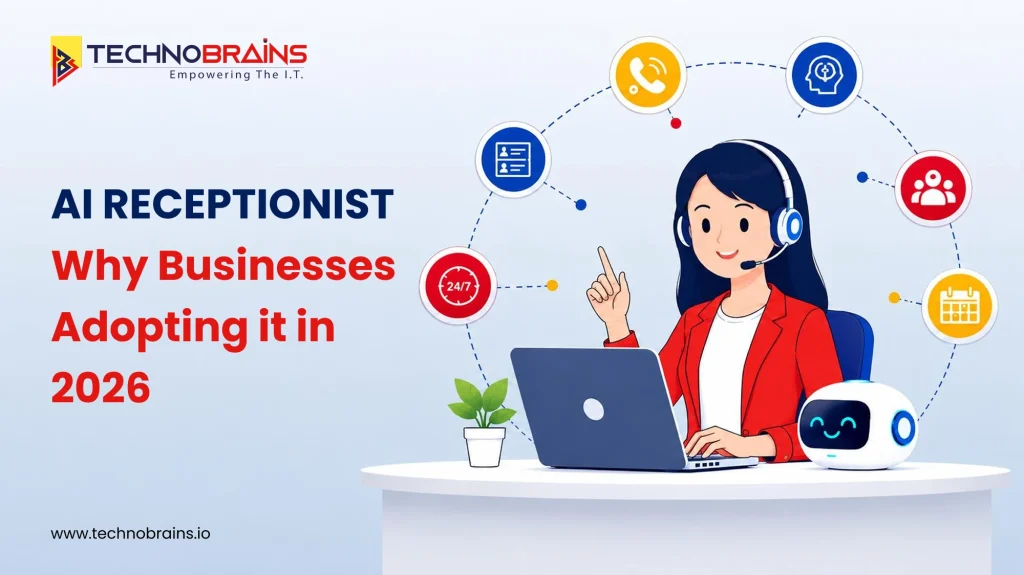
Businesses today are expected to respond to every customer inquiry promptly, provide accurate information, and remain available even after working hours. However, managing every incoming call manually can be difficult. That is why many organizations are adopting AI voice receptionist solutions to automate call handling and deliver a faster, more consistent customer experience.
AI receptionist software is an intelligent virtual assistant that answers phone calls, understands spoken requests, responds naturally, routes callers to the appropriate department, schedules appointments, captures lead information, and answers frequently asked questions without requiring human intervention.
In this guide, you’ll learn what an AI voice receptionist is, how it works, key features, business benefits, common use cases, the technology behind it, the development process, estimated costs, and the best practices for building a scalable solution.
What is an AI Voice Receptionist?
It is an intelligent call-handling system that answers business phone calls using Artificial Intelligence, speech recognition, and natural language processing. Unlike traditional IVR systems, which depend on human receptionists and can handle only one call at a time, it understands spoken conversations, responds naturally, and assists customers in real time.
Modern AI voice receptionists can answer common questions, route callers to the right department, schedule appointments, qualify leads, collect customer information, and even integrate with CRM, scheduling, and business management systems.
How AI Voice Receptionists Work: From Call Handling to Intelligent Conversations
An AI voice-enabled assistant combines conversational AI, speech recognition, NLP, and workflow automation to answer calls and assist customers in real time. Instead of fixed call menus, it understands natural conversations, identifies the caller’s intent, and performs the appropriate action automatically.
Here’s how automated receptionists work:
- Call reception: The system automatically answers incoming calls without delays, ensuring customers receive immediate assistance after business hours.
- Speech-to-text: The caller’s voice is converted into text using speech recognition technology.
- Intent recognition: Using natural language processing and AI models, the virtual receptionist analyzes the conversation to understand the caller’s intent, whether it is booking an appointment, requesting information, checking an order status, or speaking with a specific department.
- Response generation: Based on the customer’s intent, AI generates a relevant, context-aware response that guides the caller through the conversation in a human-like manner.
- Text-to-speech: The generated response is converted into natural-sounding speech using advanced text-to-speech technology for smooth and engaging conversations.
- Action execution: Once the request is understood, the system completes the required task, such as routing the call, scheduling appointments, capturing lead information, updating CRM records, creating support tickets, or escalating the conversation to a human agent when necessary.
By combining these technologies into a single workflow, AI receptionists do far more than just answer calls. They automate routine interactions, improve response times, reduce manual workload, and provide businesses with a scalable solution that delivers consistent customer support 24/7.
Key Features of AI Receptionist Systems
As we already know, an AI-powered receptionist does much more than call receiving; it automates routine conversations, improves customer interactions, and streamlines business operations by combining AI with workflow. The right solution helps businesses reduce manual effort, respond faster, and deliver consistent customer service around the clock.
Here are the key things that an AI voice receptionist solution for business can do well:
- 24/7 call handling: Answer every incoming call instantly, even outside business hours, ensuring customers always have access to support and reducing missed business opportunities.
- Natural language understanding: Understand customer requests through natural conversations instead of requiring callers to navigate menu options.
- Smart call routing: Identify the caller’s intent and automatically route calls to the appropriate department, team member, or support queue.
- Appointment scheduling: Schedule, reschedule, and cancel appointments automatically while integrating with business calendars to eliminate manual coordination.
- Lead qualification: Capture caller information, ask qualifying questions, and collect valuable lead details before transferring prospects to the sales team.
- Multilingual support: Communicate with customers in multiple languages for consistent service across diverse regions and customer bases.
- Real-time responses: Deliver accurate responses instantly, helping customers receive the information they need without long wait times or unnecessary call transfers.
- Context awareness: Maintain conversation context throughout the call to understand previous interactions and provide more personalized responses.
- Business system integration: Connect seamlessly with CRM platforms, scheduling apps, help desk solutions, and other business apps to automate workflows and keep customer information synchronized.
- Analytics and call insights: Track call volumes, customer enquiries, response times, and conversation outcomes through real-time analytics, helping businesses optimize customer service and improve operational performance.
A modern AI reception agent combines these capabilities to create a seamless customer experience while reducing operational costs and increasing productivity.
Need Help Planning Your AI Voice Receptionist Solution?
Get expert guidance on Voice-enabled assistant architecture, tech stack, integrations, and development cost before you start building. Talk to Our AI Experts!
Top Benefits of AI Voice Receptionists
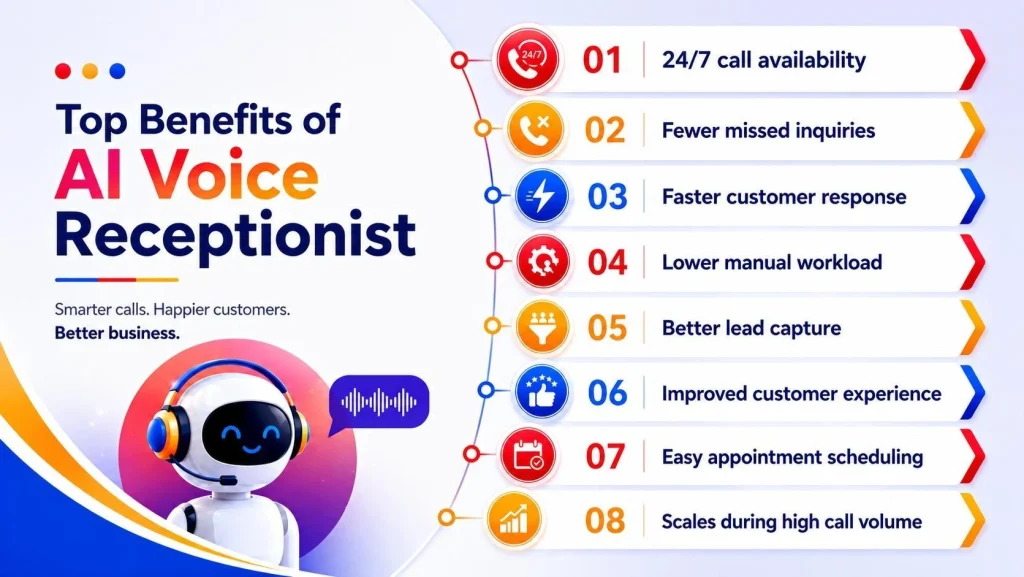
A voice AI assistant delivers far more than automated call answering. It helps businesses reduce operational costs, improve customer service, and streamline communication by handling routine interactions without human intervention. As organizations receive higher call volumes and customers expect instant responses, AI-powered call automation has become a valuable investment across various business industries.
Here are the key benefits of implementing an AI-powered receptionist:
- Reduced operational costs: Automate repetitive call-handling tasks and require fewer dedicated reception staff, allowing businesses to reduce operational expenses while maintaining high service quality.
- 24/7 availability: Answer every incoming call, including evenings, weekends, and holidays, ensures customer always receive timely assistance and reducing missed business opportunities.
- Improved customer experience: Provide instant, accurate, and consistent responses with natural conversations, shorter wait times, and faster issue resolution to enhance overall customer satisfaction.
- Increased productivity: Automate routine tasks such as call routing, appointment scheduling, lead capture, FAQs, and customer enquiries, enabling employees to focus on higher-value work.
- Higher lead conversion: Respond to enquiries immediately, qualify potential customers, and route high-value leads to the appropriate sales representatives, helping businesses capture more opportunities.
- Scalable call management: Handle hundreds or even thousands of simultaneous calls without increasing staffing requirements.
- Actionable business insights: Generate call analytics, conversation reports, and customer interaction data that help businesses identify trends, improve service quality, and make data-driven decisions.
Organizations that invest in an AI front desk assistant gain more than just call handling. They build a scalable communication system that improves operational efficiency, enhances customer engagement, reduces costs, and supports long-term business growth. By partnering with an experienced AI development company, businesses can develop customized AI voice receptionist solutions that integrate seamlessly with their existing workflows and deliver measurable business value.
Real-World Use Cases of AI-Powered Receptionist Across Industries
AI-powered voice receptionists are being used across industries to automate communication and keep things running smoothly. By automating routine conversations, handling high call volumes, and integrating with existing business systems, they help organizations improve operational efficiency while delivering a faster and more consistent customer experience.
Healthcare
Hospitals, clinics, and healthcare providers use AI voice receptionists to schedule appointments, answer patient enquiries, send appointment reminders, manage prescription refill requests, and route callers to the appropriate department. It reduces administrative workload while ensuring patients receive timely assistance.
Real Estate
Real estate agencies use AI-powered receptionists to respond to property enquiries, qualify potential buyers, schedule property viewings, collect lead information, and connect clients with available agents. This enables agencies to capture more leads without missing important calls.
Banking & Financial Service
Banks, insurance companies, and financial institutions use AI phone receptionists to answer account-related questions, assist with loan enquiries, schedule consultations, verify customer information, and direct callers to specialized support teams while maintaining secure and efficient communication.
Education & Training
Educational institutions and training providers use AI receptionists to answer admission enquiries, provide course information, schedule counselling sessions, and assist students with registration and administrative support.
Restaurants & Hospitality
Restaurants, hotels, and hospitality businesses automate table reservations, booking enquiries, order status updates, customer FAQs, and event reservations. During peak hours, AI answering services help manage high call volumes without increasing staffing requirements.
eCommerce
Online retailers use AI voice receptionists to answer order status enquiries, manage return requests, provide shipping updates, respond to product-related questions, and escalate complex issues to customer support teams, delivering faster service while reducing support costs.
Legal & Professional Services
Law firms, consulting firms, and accounting practices use AI phone receptionists to answer client enquiries, schedule consultations, capture new client information, and route calls to the appropriate legal or advisory professionals.
Core Technologies Behind Intelligent Call Handling System Development
Building an intelligent call handling system requires multiple AI technologies working together to create fast, accurate, and human-like conversations. From understanding spoken language to automating business workflows, each component plays an important role in delivering a seamless customer experience. The core technologies include,
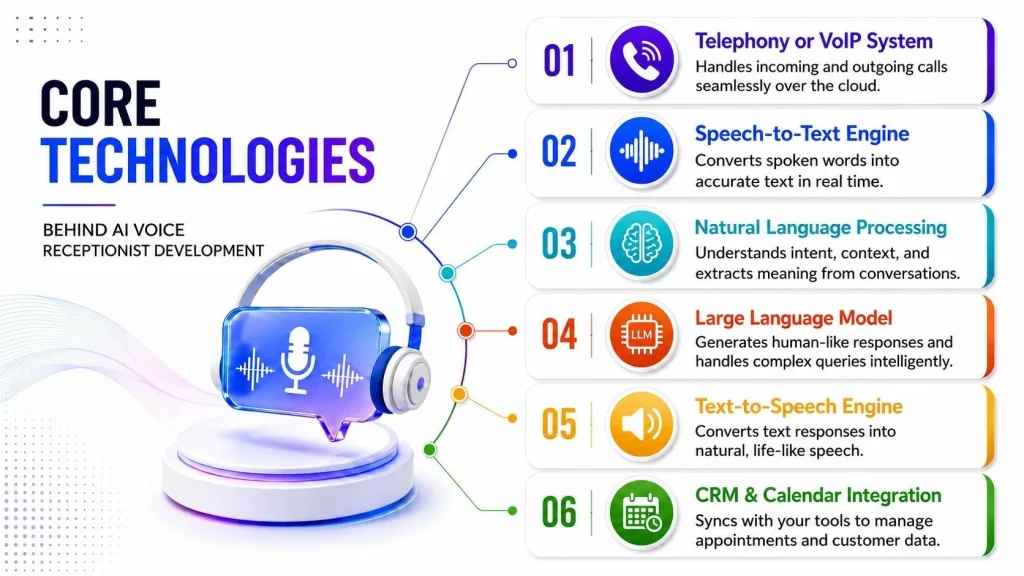
When these technologies work together, businesses can build call handling systems that go far beyond traditional phone automation.
Build an AI receptionist that works like your front desk
Create a custom AI voice receptionist system that answers calls, books appointments, routes enquiries, and captures leads without adding extra manual work. Build Your AI Receptionist!
Step-by-Step Guide to AI Voice Receptionist Development
Developing an AI voice receptionist requires more than integrating speech recognition and conversational AI. It involves understanding business workflows, designing natural conversations, selecting the right AI technologies, and continuously optimizing the system for real-world customer interactions.
Following a structured development process helps businesses build a reliable, scalable, and intelligent call-handling solution.
Requirement analysis: Start by identifying your business goals, communication workflows, and call-handling requirements. Determine the types of enquiries, the departments it should support, and the business processes it needs to automate.
Conversation design: Create natural conversation flows that guide callers through different scenarios, such as appointment booking, customer support, lead qualification, FAQs, and call routing.
Technology selection: Choose the technologies that will power the solution, including speech recognition, NLP, LLM, text-to-speech engines, workflow automation, and cloud infrastructure.
Model training: Train the model using industry-specific conversations, customer enquiries, and business knowledge so it can accurately understand user intent and generate relevant responses.
Integration setup: Connect the AI voice agent with CRM, appointment scheduling software, help desk solutions, ERP systems, payment gateways, and other business applications to automate workflows.
Testing & validation: Conduct comprehensive testing to evaluate conversation accuracy, response quality, speech recognition, security, system reliability, and integration performance. Testing across different call scenarios helps ensure the solution performs consistently in real-world environments.
Monitoring: Monitor call analytics, customer feedback, conversation success rates, and operational performance. Regular updates, AI model improvements, and workflow optimization help maintain accuracy while adapting to changing business needs.
Cost of Developing an AI Phone Receptionist
The cost of developing an AI phone receptionist depends on the complexity of the solution, the level of AI capabilities required, and the integrations needed with existing business systems. There is no fixed development cost because every organization has different communication workflows, automation requirements, and scalability goals.
Cost Breakdown
| Solution Type | Estimated Cost Range | What it Includes |
|---|---|---|
| Basic Solution | $5,000 – $15,000 | Basic call handling, limited automation, minimal integrations |
| Mid-Level Solution | $15,000 – $50,000 | NLP-based responses, CRM integrations, and scheduling features |
| Advanced Solution | $50,000+ | Full automation, LLM-based conversations, custom workflows, high scalability |
Rather than focusing only on the initial development cost, businesses should evaluate the long-term return on investment. An AI voice receptionist can reduce staffing costs, improve response times, increase lead conversion, and provide 24/7 customer support, which makes it a valuable investment for businesses.
Final Thoughts
AI voice receptionists are changing the way businesses manage customer interactions by providing instant, intelligent, and always-available support. Beyond answering calls, these systems can automate appointment scheduling, qualify leads, route enquiries, answer frequently asked questions, and integrate with existing business applications.
At TechnoBrains, we specialize in developing custom AI receptionist solutions tailored to your business processes, industry requirements, and customer engagement goals. From conversational AI development and workflow automation to CRM integration and enterprise-grade deployment, our team builds scalable solutions that help businesses streamline communication and accelerate digital transformation.
Ready to Build an AI Voice Receptionist for Your Business?
Whether you’re looking to automate customer support, improve lead management, or provide 24/7 call handling, our AI experts can help you build a secure, intelligent, and fully customized solution that grows with your business. Contact TechnoBrains today to discuss your requirements.
Frequently Asked Questions
An AI voice receptionist is an automated system that handles business calls. It helps with things like directing calls to the person and scheduling appointments.
To make an AI receptionist, you need to create a system that understands customer behaviors. Thereafter, the system turns speech into text, uses language processing to understand it, and then turns text into speech to answer people.
The development cost depends on what features you want the AI voice receptionist to have and what systems you want it to work with.
It can help industries, such as healthcare, real estate, banking, hospitality, and eCommerce.
Yes, an AI voice receptionist system is better than an IVR because it does not just answer with a yes or no; it communicates with customers.