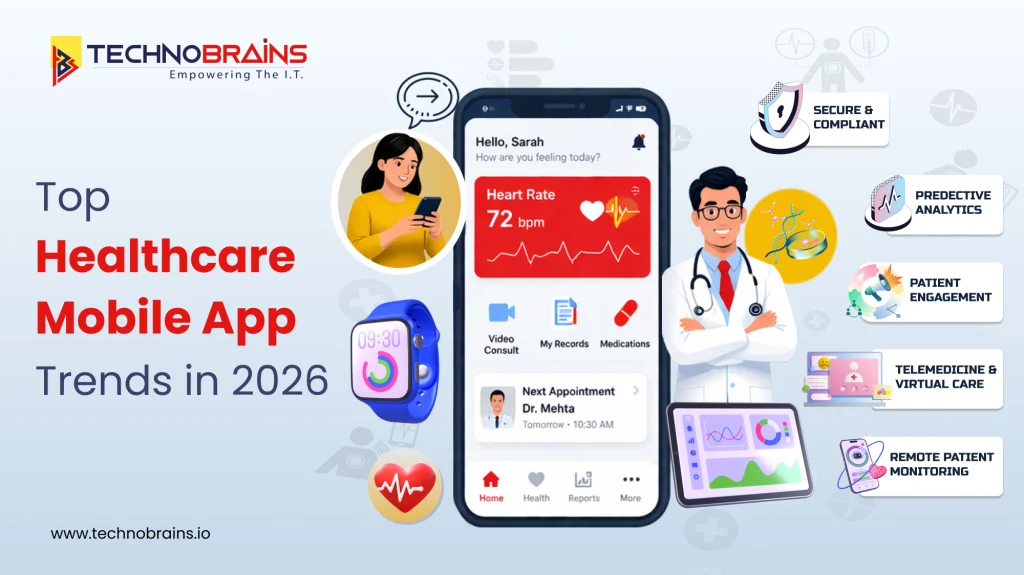
In 2026, the healthcare sector will rely on digital solutions more than ever before. Health systems require improved results between their digital platforms and patient expectations, while their medical staff must work at an increased pace. The 2026 healthcare mobile application trends now extend beyond their existing features because they determine daily medical treatment methods.
With the global mobile health apps and solutions market projected to reach US$61.8 billion in 2026, mobile applications are clearly becoming a core part of the industry’s digital foundation.
HealthTech trends demand that these applications deliver beyond their current capacity to provide user-friendly services. The system requires them to enable seamless healthcare delivery through coordination systems and patient engagement tools while maintaining data protection and decision-making capabilities across different interconnected components.
Why these Trends Matter in 2026
Mobile applications now provide more than just access to medical services. The systems now begin to determine the entire process of healthcare delivery, which includes patient treatment and all aspects of their treatment pathway. Medical apps & ERP now work as tools that healthcare professionals use for their main operational tasks, which include patient monitoring, medical record keeping, and follow-up procedures.
In today’s world, digital health trends hold significant importance because patients and healthcare providers both require better performance from digital systems. Patients want care to feel easier and more connected, while providers need apps that reduce friction and support real workflows. The most important trends that will emerge in 2026 will include systems that enhance both medical service delivery and patient treatment processes.
Key Forces Driving Healthcare Mobile App Adoption in 2026
Healthcare mobile app adoption in 2026 is being shaped by a few very practical shifts. Organizations are investing in apps that solve real care and coordination problems instead of adding more tools.
Virtual care
Care is moving beyond hospital visits, and apps are helping providers manage consultations, follow-ups, and access more smoothly. This is one reason the demand for telemedicine app solutions keeps growing.
Connected records
Healthcare apps are becoming more valuable when they connect records, prescriptions, and follow-up data in one flow. That is why EHR and HL7 integration remains a major priority for many healthcare teams.
Predictive care
The focus is moving from reactive treatment to earlier action and better decision support. That is making predictive analytics more relevant.
Patient engagement
Healthcare apps are now expected to support communication, adherence, and day-to-day interaction more effectively.
Secure design
Trust is a major adoption factor, especially in healthcare. Strong healthcare app security compliance and privacy are now shaping how apps are planned and built from the start.
Practical solutions
Healthcare buyers are looking for apps that fit real workflows and solve real operational issues. That is why businesses are turning to a healthcare app development company for custom apps that are easier to scale and integrate.
Build Your Healthcare App the Right Way
Create a healthcare app that feels easy to use, secure to trust, and ready to scale with your business. Partner with TechnoBrains to turn your healthcare app idea into a practical digital solution.
Get in Touch Now!
Top Healthcare Mobile App Trends in 2026
Healthcare mobile app trends show how apps are becoming more practical, connected, and useful across the care journey. These trends reflect where digital health is creating the most value for both patients and providers.
Telemedicine and Virtual Care Apps
Telemedicine is still one of the most important trends because virtual care has become part of normal healthcare delivery. In 2024, 71.4% of physicians said they used telehealth weekly, which shows that virtual care is no longer limited to occasional use.
What makes these apps more valuable now is that they do much more than enable video calls. The better platforms help patients book visits, message providers, complete follow-ups, and stay connected between appointments.
- Easy access – patients can reach care faster without unnecessary visits
- Smoother follow-ups – messaging and check-ins make care feel more continuous
- Better usability – strong apps fit naturally into real provider workflows
Digital Prescriptions and Electronic Health Record Apps
Digital prescription and record apps make routine tasks easier for both patients and providers. The 2025 study found that 80% of hospitals had adopted all four fundamental patient engagement functions, which indicates that healthcare facilities are moving towards better digital access to medical records and patient communication systems.
The value of these apps grows as they create systems that decrease operational disruption. Patients can access prescriptions and records more easily, while care teams can work with better information and fewer delays.
- Easier access – patients can manage records and prescriptions more smoothly
- Less friction – providers spend less time dealing with disconnected systems
- Better continuity – care stays more connected across visits and follow-ups
Remote Patient Monitoring and Wearable Healthcare Apps
Remote monitoring is becoming a much bigger part of care because it helps providers stay connected to patients between visits. Instead of waiting for the next appointment, care teams can follow important health signals earlier and respond with better context.
What makes this trend more valuable this year is that wearable healthcare apps are becoming more useful when they are tied to real care workflows. This is also why the remote patient monitoring app is gaining more attention, especially for chronic care, follow-ups, and ongoing patient support.
- Better visibility – providers can track health changes between visits
- Earlier response – issues can be spotted before they get worse
- Stronger support – patients stay more connected to their care plans
Personalized Medicine and Genomics-Based Apps
Personalized medicine and genomics-based applications are receiving increasing recognition because medical treatment is starting to shift away from standard treatments that fit all patients. The digital health applications that digital health users prefer show growing demand for personalized solutions and solutions that use data-based methods. The applications that use genetic information together with clinical history and lifestyle data create personalized recommendations that make medical care more accurate and adaptable to each patient’s individual needs.
What makes this category more useful now is that it is no longer only about storing data. The stronger platforms help clinicians and healthcare businesses connect genomics with risk patterns, treatment response, and decision support in a way that is easier to use in practice. This is also where predictive analytics in healthcare apps start to overlap, especially as providers look for more flexible ways to personalize care.
- More precision – care can be tailored around individual patient data
- Better context – genomics adds a deeper layer to clinical decisions
- Smarter support – apps can enable earlier and more personalized interventions
Gamified Healthcare and Patient Engagement Apps
The growing popularity of gamified healthcare applications arises because these applications make medical treatment more interactive while improving patient compliance. The applications use goals and rewards together with basic challenges to maintain user engagement rather than relying on reminder functions. The reason for the increasing interest in mobile healthcare apps for patient engagement across various fields, including wellness, rehabilitation, and long-term care.
When people can see progress and stay involved consistently, apps become more useful in real life. This is also where AI-powered mobile apps are starting to play a bigger role in building more engaging care experiences.
- Higher engagement – users are more likely to stay involved
- Better consistency – small goals help build healthier routines
- Stronger outcomes – better engagement can support better follow-through
Retail Healthcare and On-Demand Care Apps
Retail healthcare and on-demand care apps are growing because patients now expect basic care to feel faster access. Instead of waiting through slower traditional processes, they want quick booking, simple check-ins, nearby service options, and follow-up support in one place. That is one reason this category is becoming more visible within the future of healthcare mobile apps.
What makes these apps more useful is their focus on speed without losing practicality. The stronger platforms help users move through simple care journeys with less friction.
- Faster access – patients can book and receive care more quickly
- Less friction – basic services become easier to manage in one flow
- Better convenience – care feels more flexible and easier to use
Clinical Workflow and Care Coordination Apps
Clinical workflow and care coordination apps are becoming more important because care teams need digital tools that actually make the day easier. The better apps help manage scheduling, referrals, follow-ups, and team communication in a way that feels more organized and less fragmented.
What makes this category valuable is that it improves the work that patients usually do not see. When coordination is smoother, care teams can avoid delays, reduce manual effort, and keep care moving more efficiently.
- Less friction – routine tasks become easier to handle
- Better coordination – teams can manage care more smoothly
- Fewer delays – handoffs and follow-ups move faster
Fitness, Wellness, and Mental Health Apps
People prefer to use health applications during their routine activities instead of using them only during scheduled appointments, which drives the expansion of fitness, wellness, and mental health applications. It provides them with an easy way to control their habits, stress, and physical activity and achieve well-being through one platform, which has become common due to the existence of AI-powered apps.
These applications will have developed into relevant tools because they extend their functionality beyond basic step tracking and reminder functions. The advanced platforms enable users to improve their daily health choices through behavior tracking and guided support and AI-driven personalized experiences, which enhance their decision-making capacity about physical and mental health.
- Daily support – apps fit more naturally into everyday routines
- Better engagement – users stay involved beyond clinical visits
- Wider value – wellness tools are becoming part of connected care
Medical Courier and Healthcare Logistics Apps
Medical courier and healthcare logistics apps are becoming more important because care does not end when a prescription is written or a sample is collected. Patients and providers both need deliveries to be faster, easier to track, and more reliable across medicines, lab samples, and home care supplies.
- Faster delivery – medicines and samples move with less delay
- Better tracking – users get clearer updates across the delivery journey
- Smoother care – logistics become part of a more reliable patient experience
As healthcare continues to evolve, working with a healthcare software company becomes essential for building scalable digital solutions. Here we have listed some of the leading healthcare software development companies that will help to build scalable, secure, and connected healthcare applications
Data Security, Privacy, and Compliance in Healthcare Apps
As healthcare apps become more deeply involved in care delivery, security and compliance are no longer backend concerns. They directly affect trust, adoption, and long-term product value. Whether an app handles prescriptions, records, messages, or remote monitoring data, healthcare app security compliance and privacy now need to be built into the product from the start.
- Patient trust depends on strong privacy and secure data handling.
- Compliance can no longer be treated as a final stage requirement.
- Weak security can slow adoption, even when the app experience is good.
- Access controls and encryption are now basic expectations.
- Security planning matters more when apps handle sensitive clinical data.
- Better compliance foundations make healthcare apps easier to scale.
Why Healthcare Mobile Apps Struggle with Adoption in 2026
The healthcare applications in use today experience operational delays because they encounter technological deficiencies, workflow complications, and users lack confidence in their performance.
- Legacy systems: Many providers still work with older systems that are difficult to connect with modern apps. That makes integration slower and more complicated.
- Data privacy: Healthcare apps handle sensitive patient information, so privacy concerns are always significant. If users do not feel their data is safe, adoption drops quickly.
- Workflow gaps: An app may look good on paper, but it will not work if it adds extra steps for care teams. Healthcare tools need to fit naturally into daily workflows.
- User adoption: Not every patient or provider is comfortable using digital tools in the same way. If the app feels confusing or unnecessary, usage stays low.
- Data accuracy: Healthcare apps depend on reliable information to be useful. In areas like wearable healthcare apps, poor or inconsistent data can reduce trust and value.
Ready to Launch a Smarter Healthcare App
From telemedicine to patient engagement, build a healthcare app that supports real care journeys and long-term growth.
Talk to Our Experts!
How TechnoBrains Helps Businesses Build Future-Ready Healthcare Mobile Apps
The healthcare system needs improvements in three key areas, including enhanced connectivity, increased mobile access, and better patient-centered care delivery. The increasing number of apps requires businesses to develop digital solutions that meet actual care pathways and maintain regulatory requirements while delivering long-term value.
That’s where TechnoBrains comes in. We assist healthcare organizations in developing health applications that meet the requirements of patients, healthcare providers, and organizational objectives through our work.
Frequently Asked Questions
The biggest trends include telemedicine, remote monitoring, digital records, patient engagement, wellness apps, and better care coordination. Healthcare mobile app trends in 2026 will see their most significant changes in these particular fields.
Virtual healthcare services have become an expected part of modern medical treatment. Patients want faster access, and providers want simpler ways to manage consultations and follow-ups.
Yes, because this technology enables constant patient assessment and maintains participation during treatment. The rising need for wearable healthcare applications establishes their critical role within the industry.
These applications handle highly confidential medical information. User trust in the application serves as a fundamental requirement for user adoption of the application.
Companies should focus on usability, workflow fit, security, and HIPAA Compliance in Healthcare Software from the start. The application gains both trustworthiness and scalability through this process.