Personal assistants are not just for conversations or voice commands anymore. They are becoming a part of how companies run their daily operations, make customers happy, and get rid of boring tasks. That’s where an AI personal assistant comes in. It can handle customer questions, help employees inside the company, and bring value to businesses.
As companies have now started using AI assistants, people always ask: how much money does it take to build one? The answer is not always the same. For companies, knowing the cost to develop a virtual assistant is the first thing they need to figure out before starting to build it.
The cost of developing an AI assistant depends on many things, like what features it has, how complicated it is, what other systems it needs to work with, and how smart it needs to be. Companies that understand what things will cost and what they are getting into can build AI assistants that work well and can grow with their business.
What is AI Personal Assistant?
A personal assistant that uses Artificial Intelligence is a computer program that uses tools like Natural Language Processing (NLP), machine learning, and automation to talk to people and do tasks. These programs are made to do more than simple tasks and give real help, especially when companies evaluate the benefits.
Unlike chatbots, personal AI assistants can handle harder conversations. When you compare both, it shows how smart and capable they are. They can get what you mean, remember talks, and work with company systems to do things better. This makes them more helpful in business situations where just following rules is not enough. Businesses need solutions that are easier and smarter to adapt.
AI Personal Assistant Development Cost Overview
The AI assistant development cost in 2026 is usually between:
| Assistant Type | Features | Cost |
|---|---|---|
| Basic | AQ, simple automation | $10k–25k |
| Mid-level | NLP, CRM integration | $25k–70k |
| Advance | Voice AI, personalization, analytics | $70k–150k+ |
When companies ask how much it costs to build an AI assistant like Siri, the cost is usually higher. This is because it has advanced AI capabilities and can process voices. It also works with a lot of systems and integrations. A basic AI personal assistant can do things and follow set plans. A more advanced assistant can recognize voices and make smart suggestions. It can also work closely with business tools.
The biggest reason for the difference in cost is how adaptable the AI assistant needs to be. An assistant that is more intelligent needs data and training. It also needs complex integration.
Top Factors Affecting AI Assistant Development Cost
The factors affecting AI personal assistant development cost are not just about how many hours it takes to develop. These things also affect how complicated the solution is, how well it can be scaled, and how well it works. If you understand these things, you can get a clear idea of the development cost breakdown by features.
Feature complexity
The more advanced the features are, the more it costs to develop them. If you just want your assistant to answer questions, it will cost less than if you want it to make decisions in real time or predict what you will do next.
Natural language capabilities
If you want your assistant to understand what people are saying, you have to train it a lot. That takes a lot of data and work.
Integrations
If you want your assistant to work with systems, like customer relationship management systems or application programming interfaces, that takes more work to develop.
What platform do you choose?
If you want your assistant to work on the web or on phones or on voice assistants or on all of them, that affects how much it costs to develop.
What data do you need?
AI systems need data to work. It takes work to get that data, clean it up, and use it to train the system.
User interface and experience design
If you want your assistant to be easy to use, especially if it is an interface, you have to design it carefully and test it a lot.
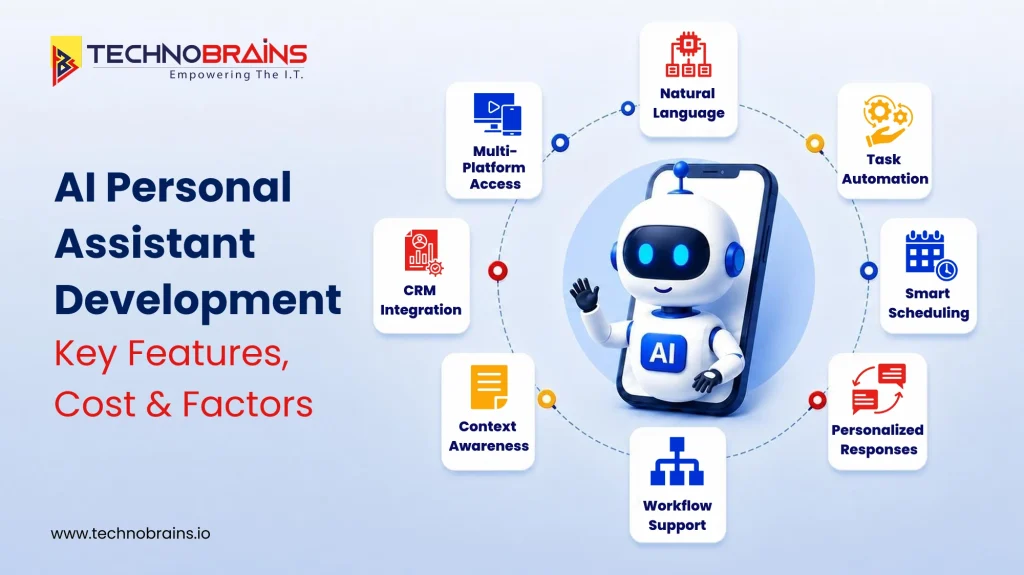
Must-Have Features of a Personal AI Assistant
The features of a personal AI assistant for business automation are really important because they decide how well the solution can make things better and easier for people to use. It works well needs to have some really good features.
- Natural language understanding: It understands what people are asking in a way that feels like a human is talking to them.
- Task automation: This means the AI personal assistant can do things like schedule appointments or get information from elsewhere.
- Multi-platform support: This feature makes sure the AI personal assistant works on lots of platforms, like the web or a mobile phone, or even messaging apps.
- Integration capabilities: This means the AI personal assistant can connect with systems that a company uses, like CRM, ERP, or tools for getting help.
- Context awareness: The AI personal assistant remembers what people talked about before so it can give relevant answers to their questions about an AI personal assistant.
Advanced AI Features:
- Voice Speech Processing: Lets people talk to the assistant without using their hands and makes it easier for everyone to use.
- AI Personalization: Allows the assistant to deliver responses tailored to each user’s preferences and behavior, often guided by insights to make interactions more relevant and effective.
- Predictive Analytics: Helps the assistant figure out what people need and suggests things before they even have to ask.
- Multilingual Support: It can be used by people who speak different languages, which is really useful for businesses that work with people from all over the world.
- Continuous Learning Models: Let the assistant get better and better over time as it learns from the people who use it.
Get a Realistic Cost Estimate for Your AI Personal Assistant Project
Find out what it takes to develop a business-ready AI assistant with the right features, integrations, and development scope.
Get a Custom Cost Estimate!
Process and Timeline for Building a Virtual AI Assistant for Business
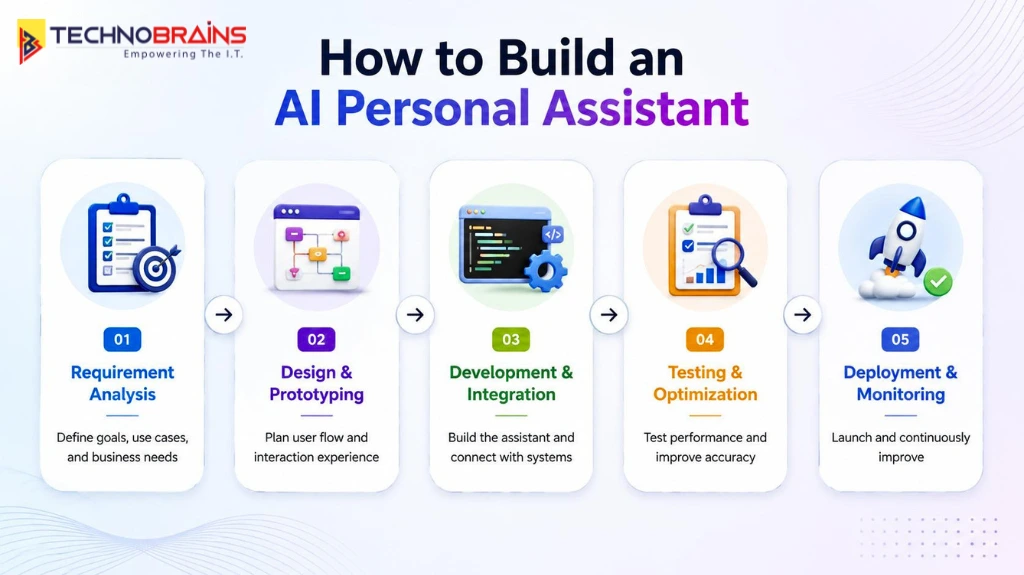
The step-by-step process for developing an AI virtual assistant involves ensuring the assistant works well. Does what the business wants it to do. Here are the things to do:
- Requirement Analysis: This is where you learn about what the business wants, what the assistant will be used for, and what you want to happen.
- Design & Prototyping: Make a plan for how the assistant will communicate to people and how they will interact with it.
- Testing & Optimization: Improve the assistant by evaluating performance, running AI testing and validation, and making sure it delivers accurate results and a smooth user experience.
- Monitoring: Deploy the assistant and continuously optimize and support it to ensure it performs reliably over time.
How long it can take to develop a full system
- Basic: 1 to 2 months
- Mid-Level: 2 to 4 months
- Advanced: 4 to 8 months or more
Benefits of AI Personal Assistants for Enterprises
AI assistants are helping lots of industries work better and make users happier. Here’s how AI personal assistants help various industries:
Healthcare
In healthcare, they help patients with scheduling appointments, answering queries, and managing follow-ups, making care more accessible and efficient. They also work alongside healthcare software to streamline hospital/clinical operations and improve the overall patient care experience.
Banking & finance
They answer customer questions, help with transactions, and alert customers about fraud. This makes banking and finance secure.
Retail & eCommerce
AI assistants provide personalized recommendations, automate order tracking, answer customer questions, and reduce support workload while improving customer satisfaction. In our last blog, we explained the Top 20 Ways in Which AI is Revolutionizing eCommerce Trends. Take a look!
Enterprise operations
Automate workflows and assist employees with various tasks. This helps companies work efficiently.
Hidden and Ongoing Costs to Consider Before Building AI Assistant
When figuring out the cost to develop an AI virtual assistant app, a business should think about long-term expenses. A clear understanding of the development cost breakdown should always include these ongoing costs.
Maintenance and updates
To keep the app running properly, regular maintenance is needed. This covers bug fixes, performance improvements, feature updates, and making sure the app continues to work smoothly across new devices and system versions.
Cloud infrastructure
Cloud infrastructure is another ongoing cost to consider. It includes hosting, storage, servers, and the computing power needed to support the app. As usage grows, these costs usually grow too.
AI model training
AI models cannot be left untouched after launch. They need regular training, tuning, and updates to stay accurate, improve responses, and match changing user needs over time.
Security & compliance
Keeping user data safe is a major part of long-term app costs. This includes security updates, secure login systems, regular checks, and adherence to privacy or industry regulations.
How to Choose an AI Assistant Development Partner
Choosing the right AI development partner can make a big difference in your project success. This becomes even more important when you are looking for an AI assistant development company that not only understands the technology but also your business goals. At TechnoBrains, the focus is on building AI solutions that are practical, scalable, and aligned with real business needs, not just technically sound.
What sets TechnoBrains apart:
- Experience in building scalable AI-driven solutions
- Strong focus on real business use cases, not just technology
- End-to-end development support, from strategy to deployment
- Flexible engagement models suited for both startups and enterprises
This approach helps businesses build AI assistants that are not only effective but also ready to deliver value in real-world scenarios.
FAQs
The development of an assistant similar to Siri requires a budget that ranges from $80000 to $150000+. The total expenses will depend on the specified requirements for intelligence and voice capabilities, system connections, and personalized solutions.
The majority of AI assistant development projects require a time frame that extends from two to eight months. The basic assistant development process requires less time than developers need to create an advanced system, which needs extended development time.
The total project cost depends on system features, which include artificial intelligence functions, platform compatibility, and data system requirements. Projects that also involve CRM usually need more time and budget.
A chatbot performs basic user conversations by following predefined operational rules. The AI assistant possesses advanced abilities because it can understand contextual data and learn new information during its work activities.
Yes, AI assistants can connect with both CRM and ERP systems, API interfaces, and multiple business applications.