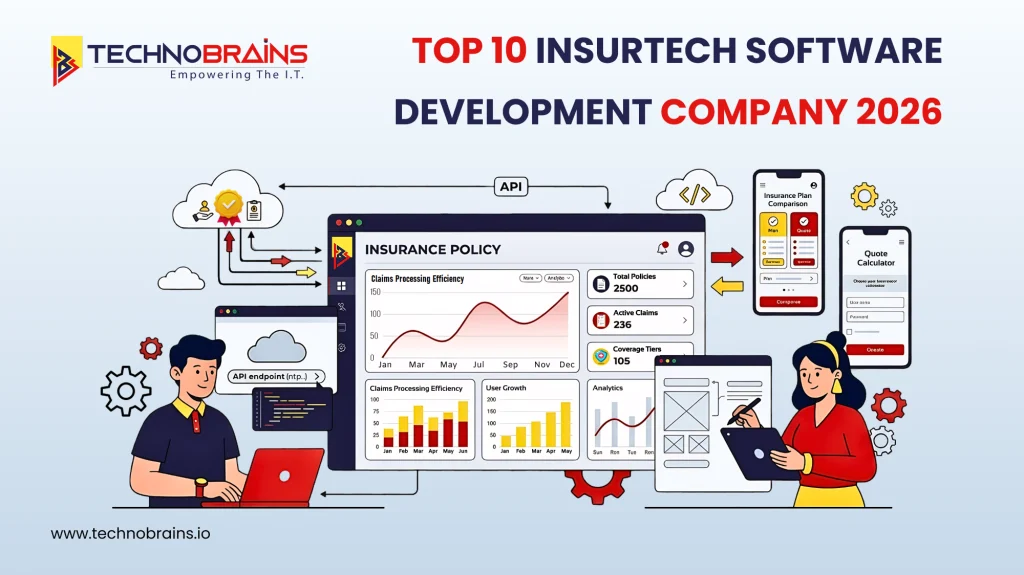
Insurance companies are under increasing pressure to modernize, but very few can afford the right technology partner. From legacy systems and slow claims processing to rising customer expectations, insurers can no longer rely on outdated platforms.
As the global insurtech market is projected to reach $23.54 billion by 2026, businesses are actively looking for top insurance software development companies that can deliver scalable and secure digital solutions.
In insurance, the challenge is not just building a digital product. It is building systems that work across claims, underwriting, policy management, compliance, and older core platforms without creating new problems.
How We Selected the Best InsurTech Software Development Companies
Not every ranking is built the same way. For this list, the focus was on what matters most in insurance projects: domain experience, integration strength, security, delivery proof, technical depth, and long-term fit. The goal was to highlight companies that look credible and ready for real work.
Insurance-specific experience
The first check was simple: Does the company really understand insurance? The stronger InsurTech software companies usually show real work in claims, underwriting, policy administration, portals, or modernization, as the system has its own workflows and complexity.
Integration and modernization ability
A good team should know how to work with older systems, not just build something new. Many insurers still rely on legacy platforms and disconnected tools. That is why clear modernization and integration experience mattered in this shortlist.
Security and compliance readiness
Insurance platforms handle sensitive customer and policy data, so security cannot be an afterthought. A development team should think about data protection, audit readiness, and operational control from the start.
Proof of delivery
We also looked for public proof behind the company’s positioning. Case studies, client reviews, certifications, and project history help show whether a team has real delivery experience. It does not guarantee fit, but it does add credibility.
Product range and technical depth
Another factor was how broadly the company could support insurance product needs. Teams that can handle portals, workflow automation, analytics, and even related work are usually better prepared than firms with a narrow scope.
Long-term fit
The final shortlist favored companies that look like dependable long-term partners, not just short-term vendors. Support, maintainability, communication, and scalability all matter here, especially in custom insurance software.
Also Read: How much does it cost to develop a FinTech app?
List of Top 10 Insurance Software Development Companies
Here’s a quick comparison to help you evaluate the top insurance software development companies based on the strengths and ideal use cases:
| Company | Best For | Key Strength | Ideal For |
|---|---|---|---|
| TechnoBrains | Custom insurance platforms | Flexibility & scalability | Startups & enterprises |
| TechMagic | Insurance-focused app delivery | Domain expertise | Product-driven insurers |
| DICEUS | Structured enterprise solutions | Workflow & compliance knowledge | Mid to large insurers |
| Limeup | UX-focused insurance products | Product design & user experience | Customer-facing platforms |
| N-iX | Large-scale modernization | Data & system integration | Enterprise insurers |
| Innowise | Automation & AI solutions | Deep technical expertise | Data-driven insurers |
| Binary Studio | Product-focused development | Clean delivery process | Product teams |
| Avenga | Enterprise transformation | Large-scale delivery capability | Large organizations |
| Cleveroad | Balanced development approach | Practical implementation | Growing insurers |
| Techling | Flexible & smaller projects | Cost-effective & agile | SMEs & startups |
1. TechnoBrains Business Solutions
TechnoBrains is a strong fit for businesses that need custom-built fintech platforms instead of rigid, off-the-shelf products. Established in 2009, the company positions itself around tailored software delivery for startups and enterprises.
Key services: AI consultant & development, custom software solutions, web & mobile app development, cloud solutions, and website design.
Industries: Finance, healthcare, education, hospitality, retail & eCommerce, manufacturing, and other business-focused sectors.
Why choose:
TechnoBrains is a strong choice for businesses seeking a practical build partner with broad solution capabilities. Its positioning centers on custom software, long-term delivery support, and industry-specific development, which can work well for insurers seeking an insurtech partner to handle evolving requirements across multiple product layers. TechnoBrains is a practical fit for businesses looking for an AI-powered insurance system with stronger engineering depth.
2. TechMagic
TechMagic is a good fit for insurers that want a team with clear insurance-focused delivery, not just general software experience. It is a practical choice for insurers building policy, claims, or customer-facing platforms.
Key services: App development, MVP development, legacy modernization, web and mobile development, API development, and integrations.
Industries: Fintech, healthcare & fitness, hospitality, HR, and other digital product sectors.
3. DICEUS
DICEUS is for insurers who need a more structured technology partner with clear insurance experience. It focuses on insurance workflows like claims, underwriting, and policy administration. It is a solid choice for insurers looking for reliable delivery across both customer and back-office systems.
Key services: Custom software development, UI/UX design, modernization, testing, and maintenance.
Industries: Insurance, fintech, banking, healthcare, retail, logistics, and more.
4. Limeup
Limeup is a good choice for insurers that want a partner with a stronger product and design mindset. The company feels well-suited to teams that want to improve both user experience and insurance workflows, especially when modernizing customer-facing platforms. Their work across claims, underwriting, and policy workflows makes it a practical option for businesses looking for insurance software developers for legacy modernization and cleaner digital experiences.
Key services: Software development, legacy system integration, UI/UX design, product development, and AI-led automation.
Industries: Fintech, healthcare, real estate, manufacturing, edtech, gaming, and logistics & supply.
5. N-iX
N-iX stands out as an excellent choice for insurance companies that require a technical partner to assist with their platform redesign work and system integration needs. The dedicated insurance product of the company provides complete coverage for claims management, underwriting processes, policy administration, and document handling systems. It feels like a practical choice for teams that need modern platforms without losing control of older systems.
Key services: Insurance software development, cloud migration, API integration, claims and underwriting automation, data solutions, and fraud prevention.
Industries: Financial services, retail, telecom, healthcare, and manufacturing.
6. Innowise
Innowise is a strong option for insurers that need a more technical partner for automation and redevelopment. The company has a dedicated insurance offering and clearly covers areas like underwriting, claims, policy workflows, and fraud-related automation.
Key services: Insurance software development, automated underwriting, claims automation, risk management tools, fraud detection, cloud solutions, and data-focused platforms.
Industries: Finance, healthcare, pharma, e-commerce, banking, and other enterprise software sectors.
7. Binary Studio
Binary Studio is a good fit for insurers that want a more focused product team, not just extra development capacity. The company has dedicated insurance pages covering claims, policy workflows, portals, and mobile products, which gives it stronger insurance relevance than a general software vendor. It’s a practical option for businesses looking for insurance claims management software and support with a cleaner delivery process and stronger workflow understanding.
Key services: Custom insurance software, web and mobile apps, claims management systems, underwriting software, portal development, and ongoing support.
Industries: Insurance, fintech, healthcare, logistics, and other product-led sectors.
8. Avenga
Avenga is a good choice for insurers that need a larger tech partner for modernization and complex insurance platforms. The company has a dedicated insurance offering and also highlights work in fraud detection and digital transformation.
Key services: Custom insurance software development, customer-facing apps, cloud solutions, fraud detection, analytics, and digital transformation.
Industries: Banking & finance, automotive, retail & eCom, telecom, manufacturing, and more.
9. Cleveroad
Cleveroad is a good fit for insurers that want a practical partner for claims, policy, and customer-facing platforms. The company has a dedicated insurance offering and clearly covers areas like workflow automation, policy management, and risk assessment.
Key services: Insurance software development, claims automation, policy management, legacy modernization, web and mobile development, and API integrations.
Industries: Fintech & blockchain, heathtech & medtech, education, retail, and travel.
10. Techling
Techling is a practical choice for insurers that want a smaller and more flexible technology partner. The company has a dedicated insurance services page and clearly positions itself around claims, underwriting, policy management, and automation.
Key services: Insurance software development, claims and policy management systems, underwriting and risk tools, automation, and custom software solutions.
Industries: Finance, healthcare, education, sports, logistics, manufacturing, and other business-focused sectors.
While these companies offer strong capabilities, businesses looking for flexible and scalable solutions often prefer working with experienced partners like TechnoBrains Business Solutions.
How to Choose the Right Insurance Software Development Company
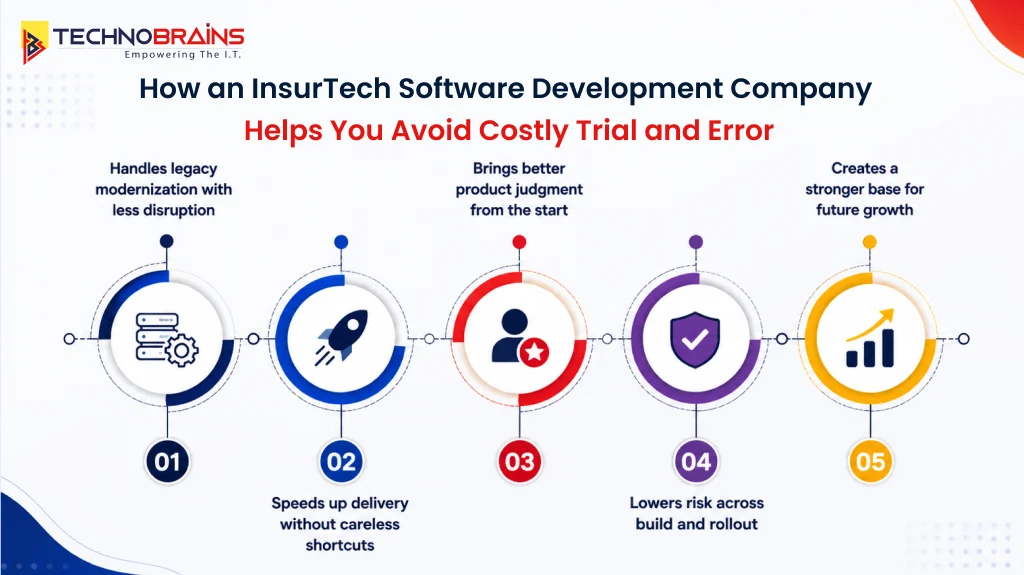
Choosing the wrong partner leads to an obvious failure. It usually shows up through delayed launches, weak integrations, rigid workflows, and expensive fixes later. That is why many businesses prefer a company that already understands insurance operations instead of starting from scratch with a general vendor.
Handles legacy modernization with less disruption
Most insurers cannot replace core systems in one go. A strong insurance software development company knows how to work with older platforms, connect new layers carefully, and modernize step by step without putting daily operations at risk.
Speeds up delivery without careless shortcuts
Faster delivery only helps when the build is stable. Experienced teams understand common insurance workflows early, which helps them move more quickly, reduce rework, and keep custom insurance software development projects from becoming messy later.
Brings better product judgment from the start
Insurance software comes with approvals, documentation, compliance steps, and operational dependencies. A team with real domain experience can make stronger decisions early and shape a product that fits the business more naturally.
Lowers risk across build and rollout
Small technical mistakes can turn into larger workflow, compliance, or security issues later. The right partner plans for reliability from day one, which helps reduce avoidable setbacks during development and after launch.
Creates a stronger base for future growth
A good system should solve current problems without limiting what comes next. The best teams build with flexibility in mind, so it becomes easier to expand workflows, improve user experience, and support long-term custom software development needs.
Why InsurTech Software Developers are in High Demand
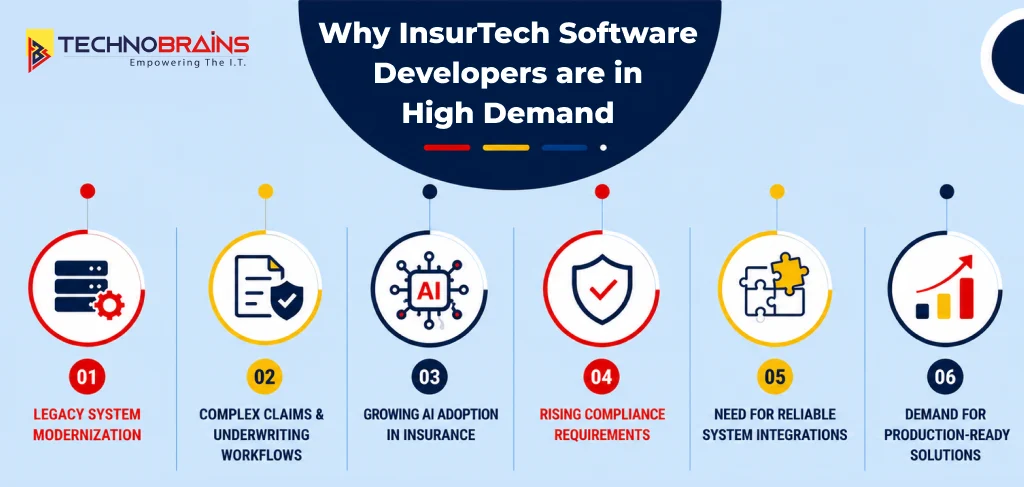
Deloitte’s 2026 insurance outlook points to modernization, changing customer expectations, and new technology pressure as major industry forces, while McKinsey notes that core system upgrades are still essential even though they are hard to execute well.
At the same time, AI use in insurance is accelerating fast, with one 2026 market report projecting the global AI in insurance market at $13.45 billion in 2026. That is why many insurers do not just want to hire software developers anymore. They want people who understand insurance logic, compliance, integrations, and how to build systems that can actually hold up in production.
Conclusion
Choosing the right partner is really about finding a team that understands insurance, not just software. When claims, underwriting, policy workflows, and legacy systems are involved, the wrong fit can slow everything down.
The insuretech companies in this list stand out for different reasons. Some are better for large-scale modernization, while others are a stronger fit for custom platforms, customer-facing products, or more hands-on delivery support.
If you are looking for a flexible, scalable, and experienced insurtech partner, TechnoBrains can help you build solutions tailored to real insurance workflows.
FAQs
Yes, an insuretech partner uses a phased approach to modernize the system, starting with new tool implementation and connecting it to existing systems through various integration methods.
The project requires an undefined duration because it depends on the project’s scope, integration requirements, compliance standards, and the extent of existing infrastructure.
The main requirements to investigate include the candidate’s expertise in the insurance field, their ability to perform system integrations, security capabilities, and a track record of successful project execution.
AI already powers existing systems that handle underwriting and claims processing, fraud detection, customer service, and internal business operations. Insurers seek partners who provide practical AI development services while maintaining governance frameworks, transparency standards, and risk management procedures.
Custom software allows insurers to build solutions tailored to their workflows, improve efficiency, enhance customer experience, and scale operations more effectively compared to off-the-shelf solutions.