Many enterprise teams have already tested what basic AI can do. The main issue with 2026 comes down to whether people will work better when the system discovers relevant information, understands context, and handles irregular tasks.
That is why Agentic RAG is now attracting attention. The knowledge distributed throughout an organization exists in various forms, including documents, tickets, tools, policies, and internal systems, which makes basic search methods ineffective. Gartner predicted that 40% of enterprise applications would feature task-specific AI agents by 2026, which marks an increase from less than 5% in 2025.
For many businesses, the main problem that Agentic RAG solves operates as the primary function for the system. The system operates between basic retrieval functions and advanced task support functions, which enable it to support business operations that require accurate information, contextual data, and verified solutions.
What is Agentic RAG?
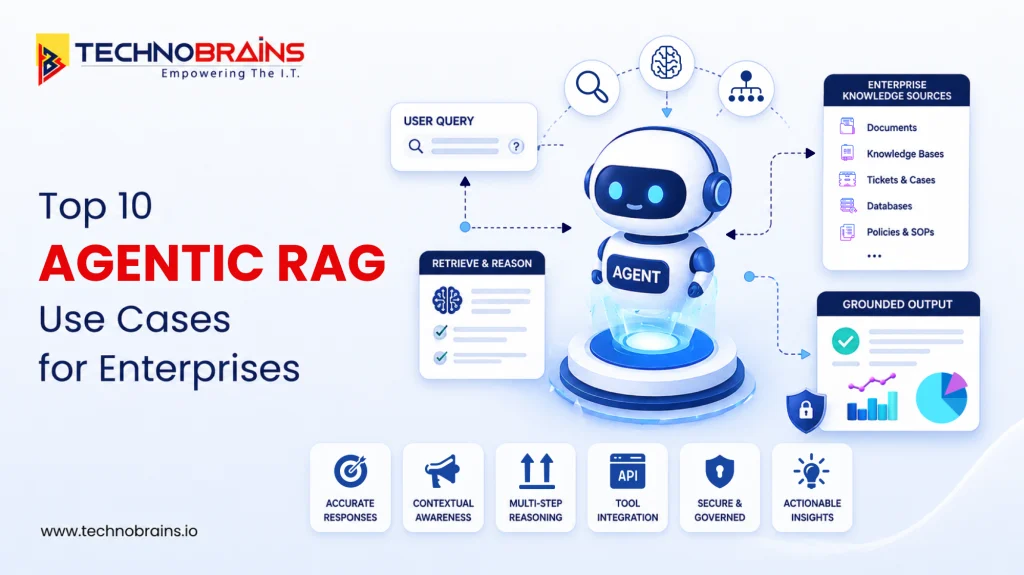
Agentic RAG is an advanced version of retrieval-augmented generation where the system does more than retrieve information and produce one answer. It can decide what to search, check whether the first result is enough, retrieve again if needed, and use tools or connected systems to complete the task more effectively. That is what makes agentic rag for enterprises more useful in complex workflows where one-step retrieval often falls short.
In simple terms, traditional RAG is built to answer with retrieved context, while agentic RAG use cases go a step further by adding planning, refinement, and more purposeful reasoning. This makes it a better fit for business environments where information is spread across documents, systems, and business tools.
How Agentic RAG Works in Enterprise Environments
Agentic RAG works as more than a simple search-and-answer system. In enterprise settings, it adds an agent layer that can decide what to retrieve and what to return.
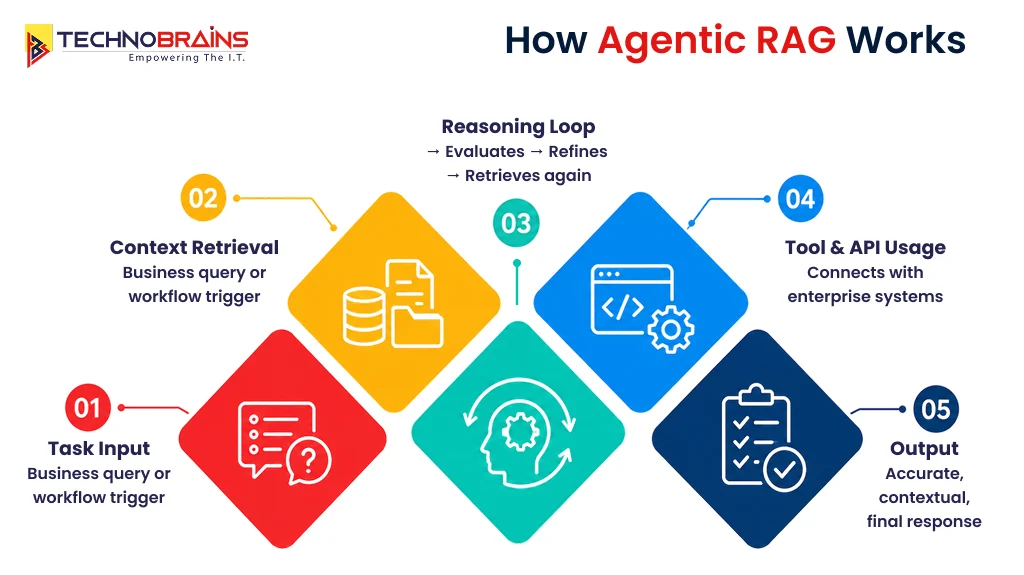
Task input
In most enterprise environments, the process starts with a task, not just a prompt. That task could be resolving a support case, checking a policy, reviewing internal knowledge, or answering a compliance-related question.
Context retrieval
The system then retrieves information from the sources connected to that task. Depending on the setup, that can include internal documents, tickets, knowledge bases, dashboards, databases, or other business systems.
Multi-step reasoning
Instead of relying only on the first result, the agent can evaluate whether the information is incomplete, too narrow, or missing something important. It can then refine the query, retrieve again, or combine multiple sources before moving forward. That extra reasoning step is one of the biggest differences between an agentic rag and a basic retrieval workflow.
Grounded output
The final output is shaped by retrieval, validation, and task context, which makes it more useful for real enterprise work. That is why agentic rag is becoming a stronger fit for support, research, compliance, and operations, where the first answer is rarely enough.
Also Read, How Agentic AI Coding Tools are Reshaping Software Development?
Agentic RAG vs Traditional RAG
Both approaches use external knowledge to improve AI responses, but they solve different problems. Traditional RAG fits simpler retrieval tasks, while agentic RAG works better for workflows that need reasoning, refinement, and multi-step support. For teams reviewing use cases, that difference matters for scalability, accuracy, cost, and speed.
| Area | Traditional RAG | Agentic RAG |
|---|---|---|
| Core flow | Follows a fixed retrieve-then-generate pattern. | Adds an agent layer that can plan, retrieve, evaluate, and try again if needed. |
| Retrieval style | Usually runs one search pass and works with the first set of results. | Uses iterative retrieval, so it can refine the search when the first context is weak or incomplete. |
| Reasoning depth | Best for direct questions with clear source material. | Better for tasks that involve multiple sources and intermediate reasoning. |
| Tool use | Usually limited to the knowledge base or retrieval layer. | Can call APIs, tools, or connected systems as part of the workflow. |
| Adaptability | Less flexible when the query is vague, or the first retrieval misses key context. | More adaptive because it can reformulate queries, choose different sources, and self-correct. |
| Speed and cost | Usually faster and cheaper for simpler use cases. | Often slower and more expensive because it uses more steps and orchestration. |
| Best fit | FAQs, policy lookup, and other clear knowledge retrieval tasks. | Support resolution, research, compliance reviews, and other complex agentic rag use cases. |
Planning an Enterprise AI Workflow That Actually Works?
We help businesses design practical AI systems built around real workflows, clean data, and long-term usability. Contact TechnoBrains!
Key Agentic RAG Use Cases for Enterprises
Customer Support Resolution
Customer support is one of the most practical places to use agentic RAG. Instead of relying on one document or a basic FAQ flow, it can pull context from product guides, past tickets, help articles, and customer history to give a more complete answer. That is why this is one of the most useful agentic RAG use cases for enterprise teams.
In real support environments, this helps teams spend less time searching across systems and more time solving the issue. For businesses exploring agentic rag for enterprises, the value here is simple: better context, faster resolution, and more helpful responses in complex cases.
Internal Knowledge Discovery
Internal knowledge discovery is another strong use case for agentic rag. In many enterprises, useful information is spread across documents, wikis, shared drives, tickets, and internal tools, which makes simple search frustrating and slow. Agentic RAG helps by pulling the right context from different sources and returning something more usable than a list of links.
In practice, this helps teams find answers faster without jumping across systems or asking around for the same information. For enterprises, the value here is better access to internal knowledge, less wasted time, and more consistent answers across teams.
Compliance and Policy Review
Compliance and policy review is a good fit when teams need answers grounded in rules, controls, and internal documentation. Instead of pulling one policy snippet and stopping there, an agentic rag for enterprises can work across multiple documents, compare context, and return a more complete response for review.
This is especially useful in workflows where teams need to check requirements, reduce manual review time, and avoid missing important details. Among practical agentic rag use cases, this one stands out because the business value is clear: more reliable answers, stronger context, and less effort spent piecing information together manually.
IT Helpdesk and Troubleshooting
IT helpdesk work is rarely solved by checking one source and moving on. Most issues need teams to look across logs, old tickets, internal guides, known errors, and system documentation before they can understand what is actually causing the problem.
That is why this is such a strong use case. It helps IT teams spend less time jumping between systems and more time fixing the issue. In real workflows, agentic rag implementation can improve troubleshooting speed, reduce repeated checks, and make support more consistent across the organization.
Research and Document Synthesis
Research and document synthesis is another high-value use case when teams need to work across reports, contracts, internal notes, articles, and structured data. Instead of pulling one source and stopping there, the system can gather context from different places and turn it into a more useful summary or comparison.
This is especially helpful for teams that spend too much time collecting information before they can even begin analysis. Among practical enterprise agentic rag use cases, this one stands out because it helps teams move from scattered documents to clearer insights with less manual effort.
Financial Reporting and Analysis
Finance work usually depends on more than one source. Teams often need numbers from internal systems, historical context, policy rules, and supporting documents before they can trust the output. That is why this is one of the more practical in enterprise settings, especially where accuracy and traceability matter.
In real workflows, this helps finance teams spend less time gathering inputs and more time reviewing the outcome. For businesses evaluating agentic rag solutions, the value here is clearer analysis, better context around financial questions, and less manual effort before decisions are made.
Sales and Lead Intelligence
Sales teams rarely work from one clean source of truth. Useful context is usually spread across CRM records, account notes, product information, past conversations, and buying signals, which makes it harder to prepare quickly. This is where agentic rag architecture becomes useful because it can pull those pieces together into something more usable.
In practice, this helps sales teams qualify leads faster, prepare with better account context, and respond with more relevant information. The value is simple: less time spent searching across systems and more time focused on moving the opportunity forward.
Supply Chain and Operations Support
Operations teams rarely get the full picture from one system. Inventory changes, supplier updates, order status, delivery issues, and internal workflows are often spread across different tools, which slows everything down. That is where agentic rag solutions start to feel genuinely useful.
Instead of making teams chase information across systems, it helps bring the right context together faster. In real operations work, that means quicker decisions, better coordination, and fewer delays when something changes unexpectedly.
Frontline Employee Assistance
Frontline teams usually need answers in the moment. They do not have time to dig through long manuals or jump between systems just to find the next step. Whether it is a process check, a policy question, or a task-related issue, the guidance needs to be quick and clear.
This is where agentic RAG for enterprises can make a real difference. It helps frontline staff get the right guidance from internal SOPs, training material, and business rules without adding extra friction. In practice, that means less confusion, more consistency, and better support during everyday work.
Leadership Decision Support
Leaders usually do not struggle with a lack of data. The real challenge is that useful context is scattered across reports, dashboards, internal updates, policies, and operational systems, which makes it harder to get to a clear view quickly. That is where agentic rag architecture becomes more valuable than a basic retrieval setup.
It helps bring together the right context before a decision is made, instead of forcing teams to manually gather everything first. In practice, that means faster summaries, better visibility across moving parts, and more informed decision-making when the situation is too broad for one simple answer.
Explore Agentic RAG for Your Enterprise
See where Agentic RAG can create the most value across support, research, compliance, and internal workflows. Get a Custom Enterprise AI Strategy!
Challenges of Agentic RAG and Practical Ways to Solve Them
The promise is clear, but agentic rag implementation gets harder once it moves from demos into real enterprise workflows. Most competitors highlight the same pattern here: the main problems are not just model quality, but retrieval accuracy, system complexity, weak observability, and governance gaps.
Retrieval quality
This is one of the biggest challenges. If the system pulls weak, missing, or loosely relevant context, the rest of the workflow starts from the wrong place. In multi-step setups, that problem can grow quickly because each step depends on the one before it.
- Clean and structure the source content before rollout.
- Use better chunking, metadata, and ranking rules for retrieval.
- Test for both over-retrieval and under-retrieval, not just answer quality.
- Start with narrow, high-value workflows before scaling wider.
System complexity
These systems are harder to run than basic RAG. They need retrieval, reasoning, orchestration, tools, and business systems to work together cleanly. That is why many agentic RAG solutions look strong in theory but become difficult in production without a clear architecture.
- Keep the first version focused on one workflow and one outcome.
- Limit the number of tools and sources in the early rollout.
- Define clear fallback behavior when the system is unsure.
- Build the workflow around real business tasks, not generic AI capability.
Visibility and control
Once the system starts taking multiple steps, teams need to see what it retrieved, why it chose that path, and where the output came from. Without that visibility, trust drops quickly, and debugging becomes much harder. Recent security guidance around agentic systems is also putting much more emphasis on observability and traceability.
- Log retrieval steps, tool calls, and decision paths.
- Track source citations and confidence signals in outputs.
- Add human review for sensitive or high-risk workflows.
- Use dashboards that show failures, retries, and weak retrieval patterns.
Access and governance
This becomes a serious issue when the system connects to internal data, business tools, or APIs. A recent survey highlighted that many organizations still struggle to distinguish AI-agent activity from human activity, and many agents receive more access than they actually need.
- Treat the system like a governed enterprise identity, not a generic app.
- Give it only the minimum access needed for each workflow.
- Separate read, write, and action permissions clearly.
- Review access paths regularly as the rollout expands.
ROI and scope creep
A lot of teams try to make the first rollout do too much. That usually leads to slower delivery, unclear value, and more moving parts than the business can realistically support. Competitor content that handles this well usually pushes teams toward smaller pilots with measurable outcomes first.
- Choose one use case with clear business pain and clear success metrics.
- Measure time saved, answer quality, escalation rate, or resolution speed.
- Avoid broad “enterprise AI” rollouts in the first phase.
- Expand only after the initial workflow proves useful in practice.
Read more on How to Build and Manage an AI Agent with N8N?
Enterprise Roadmap for Implementing Agentic RAG
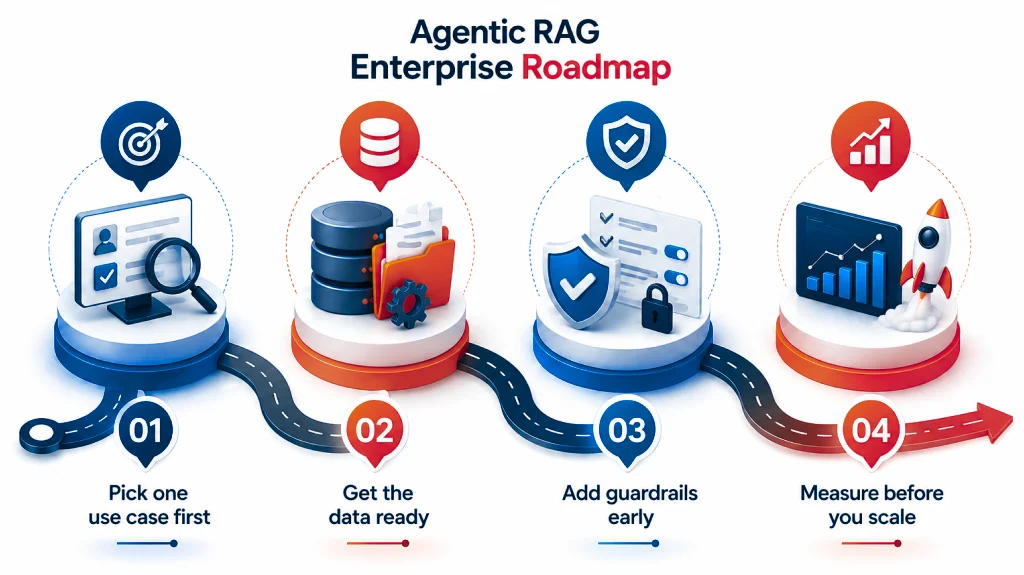
A strong rollout usually starts with one clear workflow, not a broad AI plan. The most practical approach is to solve one real business problem first, prove the value, and then scale from there. That is usually the safest way to handle agentic rag implementation in enterprise environments.
Pick one use case first
Start with a workflow that has clear business value and a manageable scope. Support, internal search, and policy lookup are common starting points because they are easier to measure and improve.
Get the data ready
Before building anything advanced, make sure the source content is clean, structured, and easy to retrieve. In most projects, better data quality matters more than model complexity at the start.
Add guardrails early
Do not begin with full autonomy. Start with tighter controls, add human review where needed, and make sure the system can show what it retrieved and why it responded that way.
Measure before you scale
Track answer quality, retrieval accuracy, and business impact before expanding the rollout. A solid agentic rag architecture grows more effectively when the first workflow is already working well.
How Technobrains Builds Agentic RAG Solutions for Enterprises
At TechnoBrains, we focus on building Agentic RAG solutions that fit real business workflows, not just AI demos.
We start by understanding how your teams access and use data across systems like CRMs, documents, and internal tools. Based on this, we design an agentic architecture that can retrieve the right information, refine context, and support multi-step tasks more effectively.
Our approach includes structured data preparation, seamless integration with enterprise systems, and secure access controls to ensure reliable and compliant AI operations.
From development to optimization, we ensure the solution delivers accurate, context-aware outputs that improve workflows like support, research, and compliance.
Conclusion
Enterprises need AI systems that can do more than return fast answers. They need solutions that can work across scattered knowledge, support more complex workflows, and deliver outputs teams can actually use in real business situations.
That is where Agentic RAG starts to make more sense. It helps businesses improve how they retrieve, connect, and use information across support, research, compliance, operations, and other high-value workflows. It is also becoming an important part of broader AI agent development as companies look for more practical enterprise AI systems.
The real opportunity is not in adopting it everywhere at once. It is in choosing the right use case, building around real business needs, and creating something that is useful from day one. Contact TechnoBrains Business Solutions today to discuss your project.
FAQs
Agentic RAG is a more advanced version of retrieval-augmented generation, where the system does more than fetch information. It can decide what to search, refine retrieval when the first result is weak, and work through a task in a more adaptive way than standard RAG.
Traditional RAG usually follows a fixed retrieve-and-answer flow. Agentic RAG adds planning, retrieval refinement, and more flexible reasoning, which makes it better suited to tasks that involve multiple sources, follow-up steps, or a more complex context.
The strongest fit is usually in support, internal knowledge search, compliance review, IT troubleshooting, research, and other workflows where one clean search is rarely enough. It tends to work best when teams need grounded answers built from scattered business information.
Not always. Many teams start by adding an agent layer to a narrow workflow instead of replacing everything at once. That step-by-step approach is usually easier to govern, easier to measure, and safer for enterprise adoption.
No. It can also support research, policy review, reporting, operations, and other knowledge-heavy workflows. That is why it is increasingly relevant in broader conversations around AI agents for enterprise apps, where the goal is to support real work instead of only answering prompts.